

I’m Tanay Jaipuria, a partner at Wing and this is a weekly newsletter about the business of the technology industry. To receive Tanay’s Newsletter in your inbox, subscribe here for free:
Hi friends,
In my previous piece, I talked about the various incentives in agentic commerce, and how that explained the different reactions of Shopify and Amazon to Meta’s Muse. I also touched on how advertising may evolve if agents are the new buyer rather than humans. This time around, I’ll focus on an obvious follow up: how might personal agents make money and how much?
At Muse Connect, Zuckerberg mentioned that his ambition for Muse is to keep it free as much as possible, and “over time we will profit by taking a small fee from transactions.”
Noah Shinn, Instinct’s founder stated that Instinct is already doing greater than 1B in annualized GMV, with travel accounting for half.
In this piece, I wanted to discuss the potential ways an agent could get paid, and in particular, quantify the last two, which are perhaps the most interesting to think through. The four main ways are:
Subscriptions: The customer pays a recurring fee to use the agent
Convenience fees: The customer pays an additional convenience fee to the agent to complete a transaction which could be a flat fee or a percentage of the transaction.
Merchant or commercial partner fees: A merchant, an aggregator or payments partner pays the agent for the work it has done in completing the transaction.
Advertising: Advertisers (i.e., merchants) pay the agent to drive incremental demand for their product.
The last two are the most interesting to quantify and what I focus on in the rest of the piece: how much could an agent earn from transaction fees and advertising?
What commerce businesses earn today
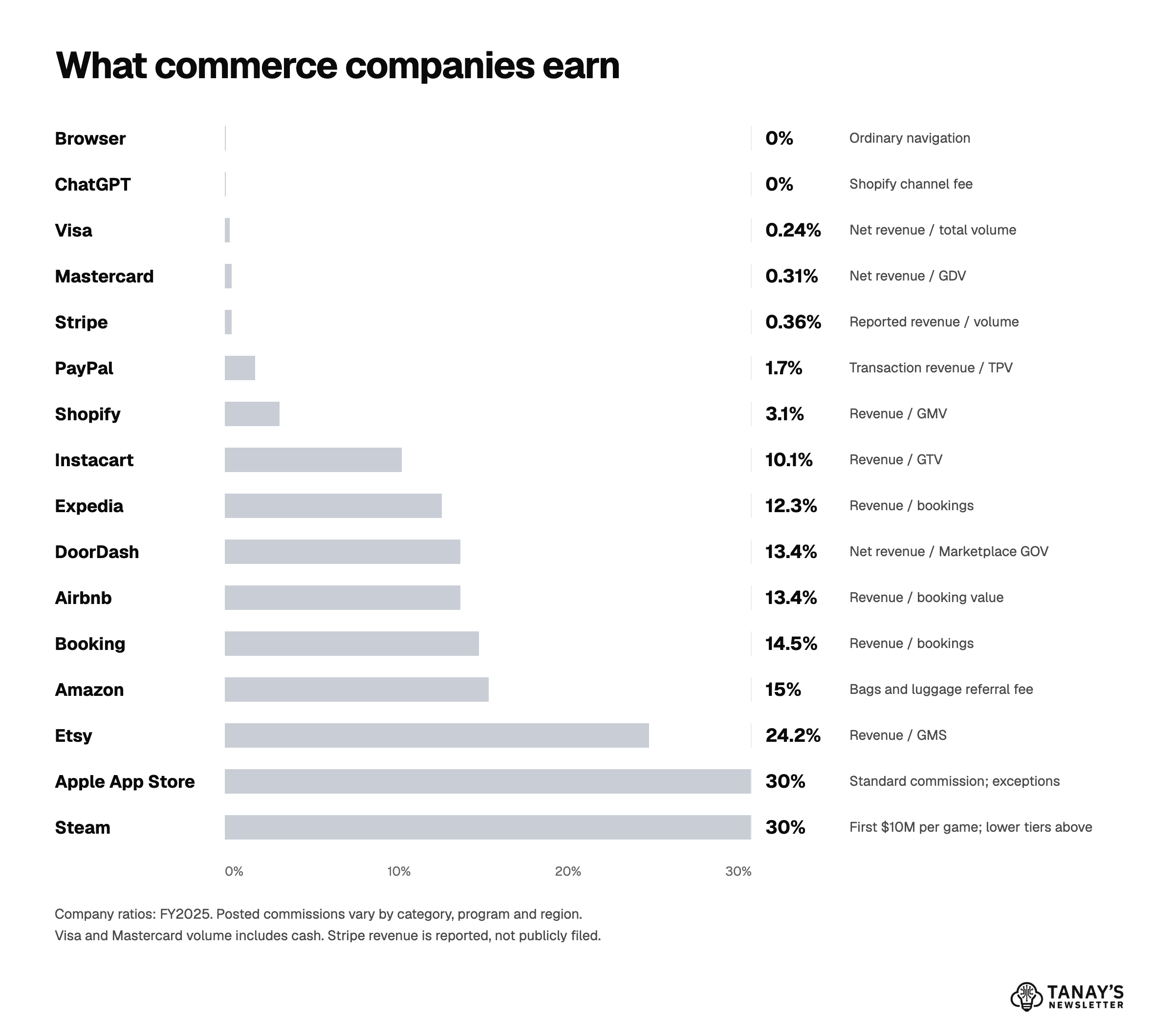
First, it’s worth considering various take rates that typical platforms or channels make in commerce. Take rates vary from 0% on the low end (for example, if you buy something on a typical web browser) to maybe 30% if someone is purchasing something through Apple App Store or Steam.
In general, the things that affect what you can charge are a mix of factors, but a few that tend to matter a lot are:
What is the value that you are providing in the transaction journey?
How involved are you in terms of customer acquisition? Is the demand incremental or would it have existed without you
How much work are you doing in terms of fulfillment, trust, and post-order processing?
How strong are the alternatives merchants have if they don’t use you?
How an agent’s role could evolve
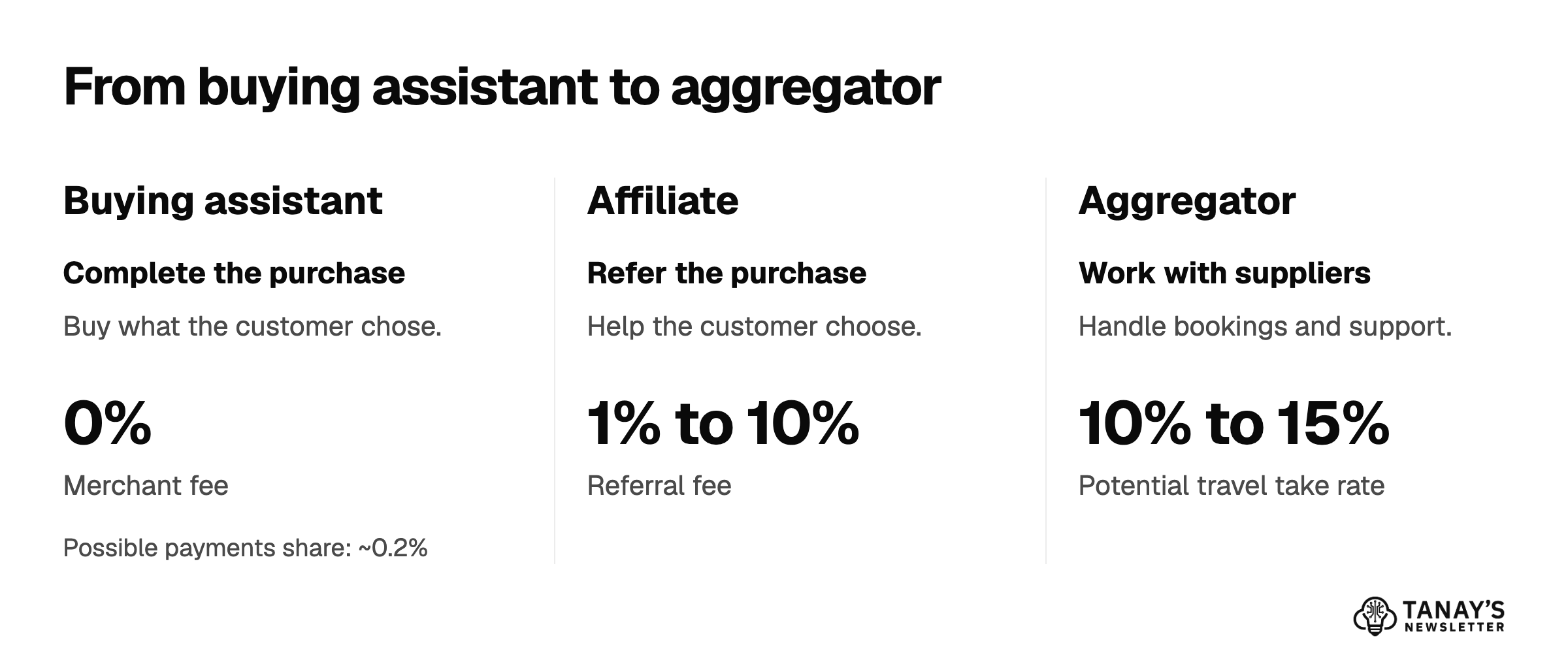
With that context, we can then think about what an agent may earn over time based on the work it is doing in a transaction. Depending on what it has negotiated or the nature of the transaction, an agent could end up playing the role of a 1/ buying assistant, 2/ an affiliate or 3/ an aggregator
1/ Buying assistant or browser++.
Today when you go and complete a transaction in a browser, the merchant does not pay the browser any fees. If you tell an agent to go book a specific hotel on that hotel’s website, the merchant should arguably not be really paying any fee to the agent.
However, since the agent reduces friction in the transactions, potentially increasing payment volumes in the long run, what it could do is negotiate some commission off the take rate that someone like a Stripe would be earning. Stripe already offers revenue sharing to eligible Connect platforms as an example. These take rates are likely small, like sub-0.5% and maybe even on the order of 0.2%.
2/ Affiliate
The next step to earning higher commissions is via referral programs or affiliate programs, which many merchants or aggregators have. The role you can think of the agent taking in these cases is that it helps someone discover a product or compare various options and then choose a specific one, referring the purchase to that merchant.
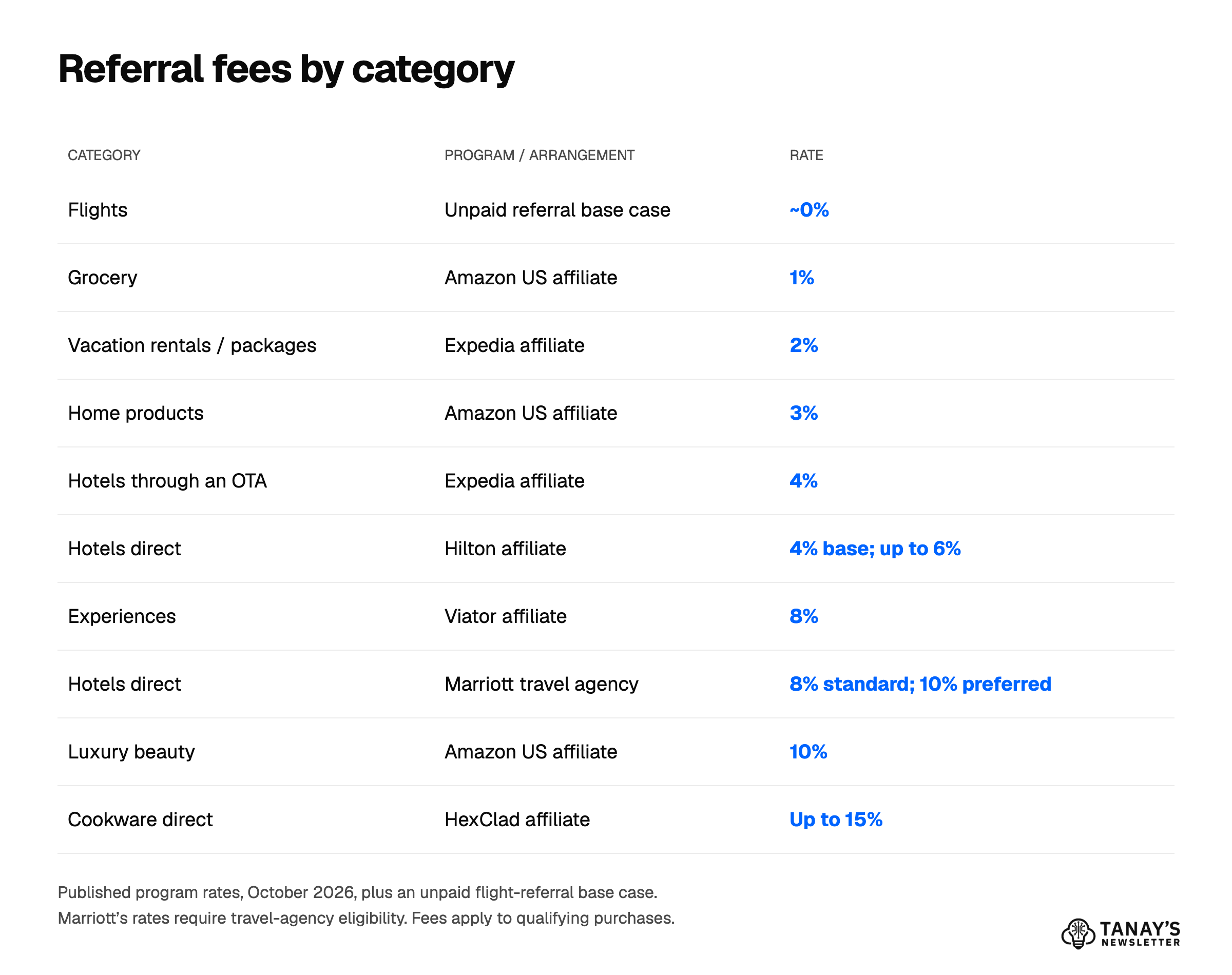
To do this, agents will need to build direct relationships / join the various affiliate programs across a wide variety of merchants. Categories also end up mattering a lot here, as one can see below for some of the published take rates by category.
Public programs pay anything from ~0% on flights to 1% on Amazon grocery purchases to 4% on Expedia hotels and 8% on Viator experiences.
What merchants will care about is that ideally many of the purchases are incremental to them. Over time, the agent being able to demonstrate that it helped the user pick this specific product/merchant will help sustain take rates (versus most of them were ones where the user told it to buy that specific product/service).
One note here is that agent platforms like Muse can have relationships with both aggregators (such as Expedia) and the merchants themselves (such as Marriott). They can use aggregators for the somewhat longer tail and the merchants for directly for other requests.
3/ Aggregator
Over time, in certain categories, there may be a world where agents decide that they want to capture more of the take rate that aggregators do. For example, Booking’s might make 14% to 15% of GMV, but the affiliate fees they provide might only net out to ~5-7%.
To earn that extra fee, agents could get more involved in directly providing inventory access, accurate prices, reliable bookings, potentially being the merchant of record and support for changes and cancellations, rather than using the aggregator itself for these things.
As one note, it may be significantly easier to “compete" or try to displace aggregators that are more digitally oriented than for aggregators/marketplaces that do a lot of work in the physical world (such as an Uber or a DoorDash).
What that could mean for the blended take rate
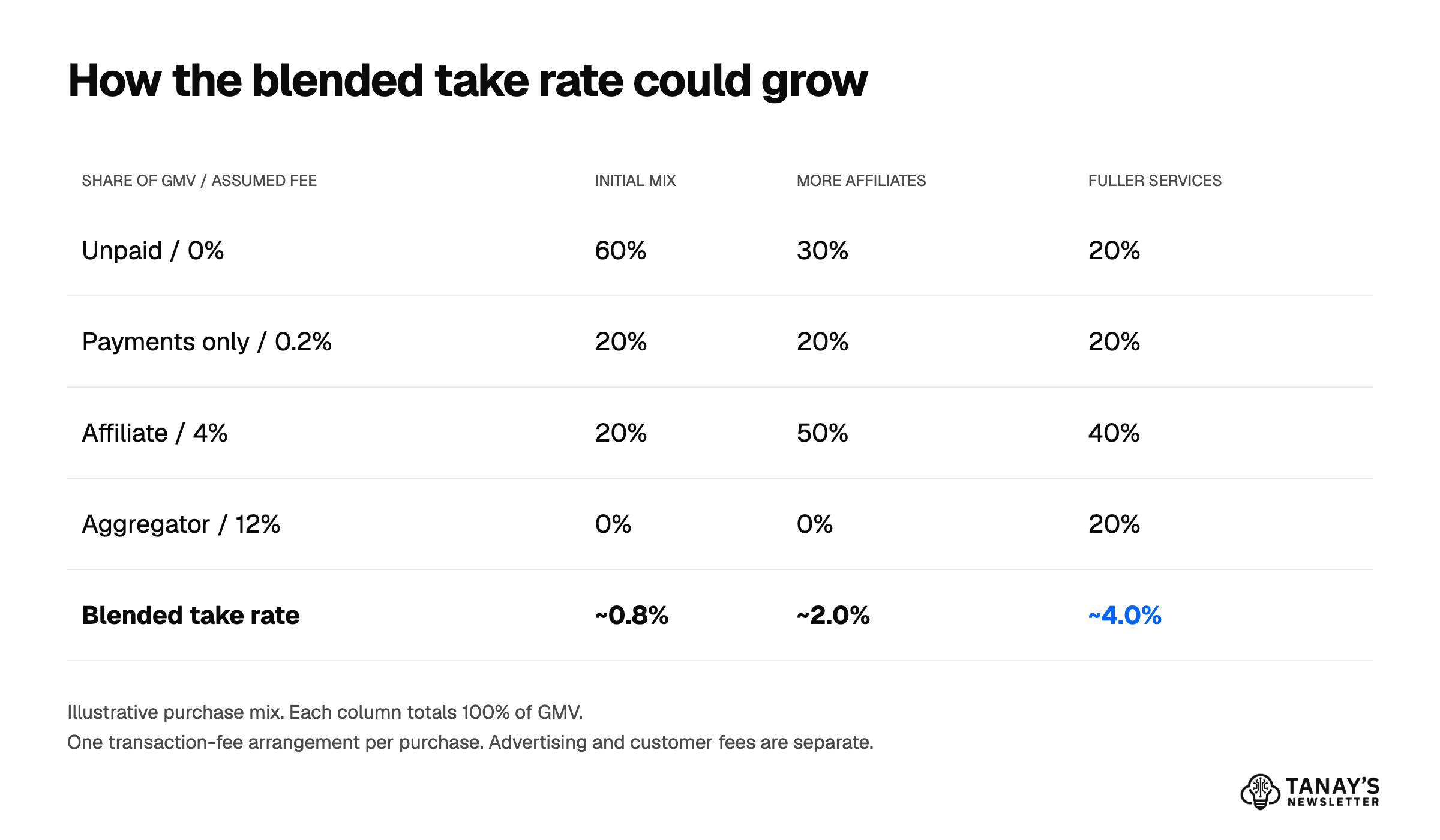
To illustrate how the take rate could evolve over time, suppose you get 0.2% on payments commission, 4% net on affiliate, and 12% as an aggregator.
You initially start with mostly payment fees and some affiliates, over time add more affiliates, and over time move to an aggregator like model for some share of GMV, as below, with take rates going from ~0.8% to 2% to 4% over time. Note that these are net take rates assuming you aren’t the payment processor.
I think there will always be a long tail without a commercial agreement in the medium term. If I ask the agent to buy a specific product from a specific merchant, it should do that even if there is no commission to it
What advertising could add
So far, we’ve largely covered the potential for agents via fees from merchants/partners, but there’s one other opportunity, which is around advertising (i.e., specifically trying to drive incremental demand for merchants).
It is possible that these don’t look like ads at all and in an agentic world, could just be paid through higher take rates, but I figure it’s still worth quantifying since we may also see other forms of ad units as well.
A merchant might pay the agent (in addition to the customer directly) to have their offer considered when someone asks for a hotel or a pair of shoes.
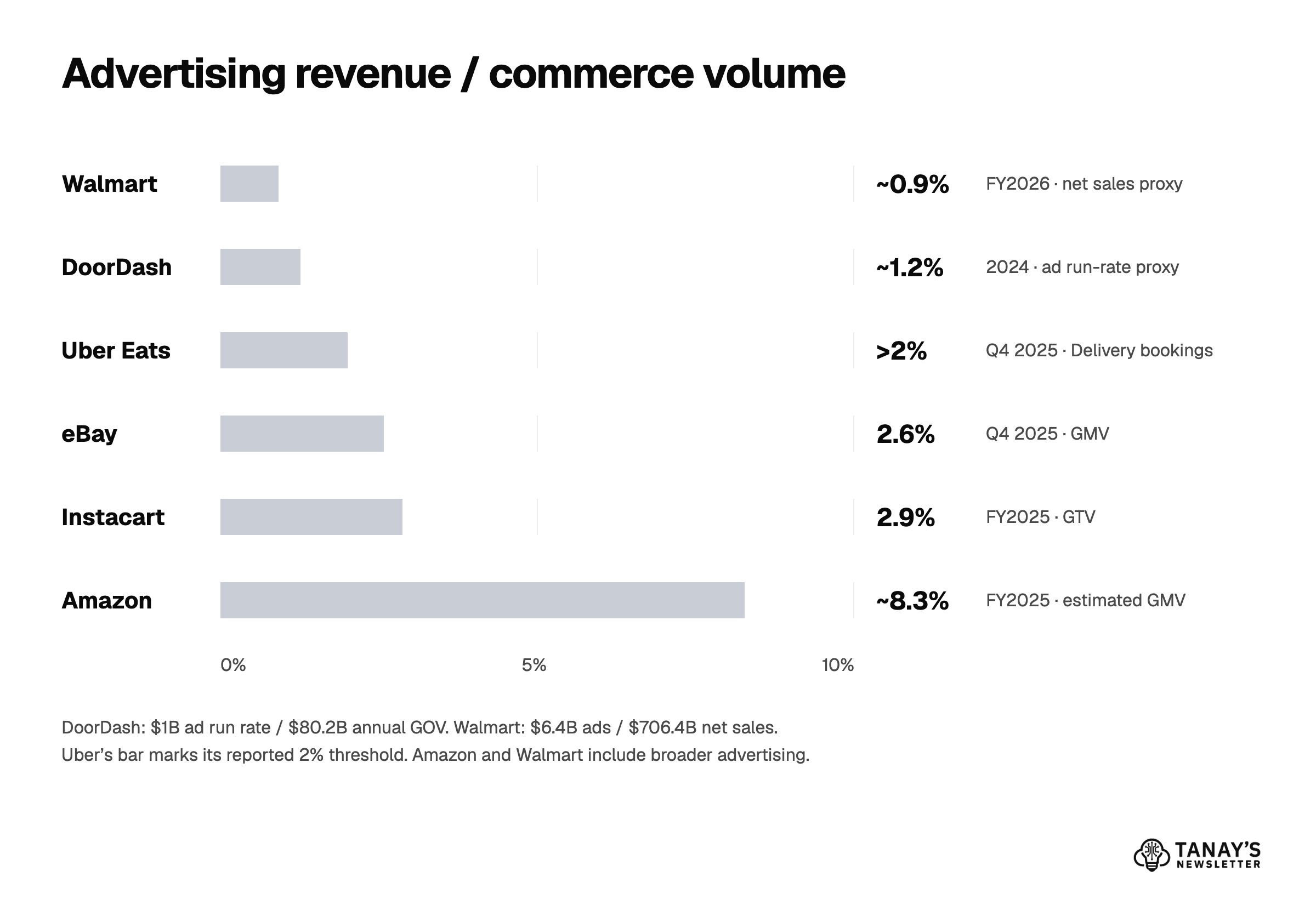
The chart above here gives us a proxy for what a platform can start to earn from advertising relative to the GMV scale it has. Amazon is the most mature and the best monetized ads business here, but it does seem that the ~2% range seems reasonable and achievable for most different kinds of platforms.
There is a lot to be figured out in terms of whether there will be ads at all, and how they work and whether they can be done tastefully.
For example, proactive ads to suggest things to buy may not be received well by users. Additionally, the agent receiving money to choose an item that may not be best for the user magnifies the principal-agent problem. The best form of ads may look like offers where the customer gets a discount (and the agent also gets paid but doesn’t alter its choice because of the payment). Regardless, even if there’s no concept of ads at all, it may suggest that there’s another 1-2% of GMV take rate possible given that merchants had that budgeted for these transactions.
It is a very exciting time with a lot to be figured out in this new medium! If you’re thinking about these things or if you have any comments or thoughts, feel free to tweet at me.