

I’m Tanay Jaipuria, a partner at Wing and this is a weekly newsletter about the business of the technology industry. To receive Tanay’s Newsletter in your inbox, subscribe here for free:
Hi friends,
Shopify and Amazon had very different reactions to Muse, Meta’s new personal AI agent that can research products and make purchases on a customer’s behalf. Shopify is making its merchants accessible through the agent. Meanwhile, Amazon has blocked it.
What’s going on here?
I’m reminded of Charlie Munger’s quote: “Show me the incentive and I will show you the outcome.”
I’ve written before about agentic commerce and how agents could handle discovery, comparison and purchasing. The Muse dispute shines light on the business-model tensions between companies. The same transaction can be attractive to some players such as Shopify while being threatening to others such as Amazon. Let’s go into it.
Shopify’s incentives

Shopify’s pitch to merchants is that it helps them sell wherever their customers are. If customers start shopping through agents, Shopify wants to make sure its merchants show up there too.
Concretely, the two main ways Shopify makes revenue is:
Subscriptions, from the merchants choosing to use Shopify to run their online storefront
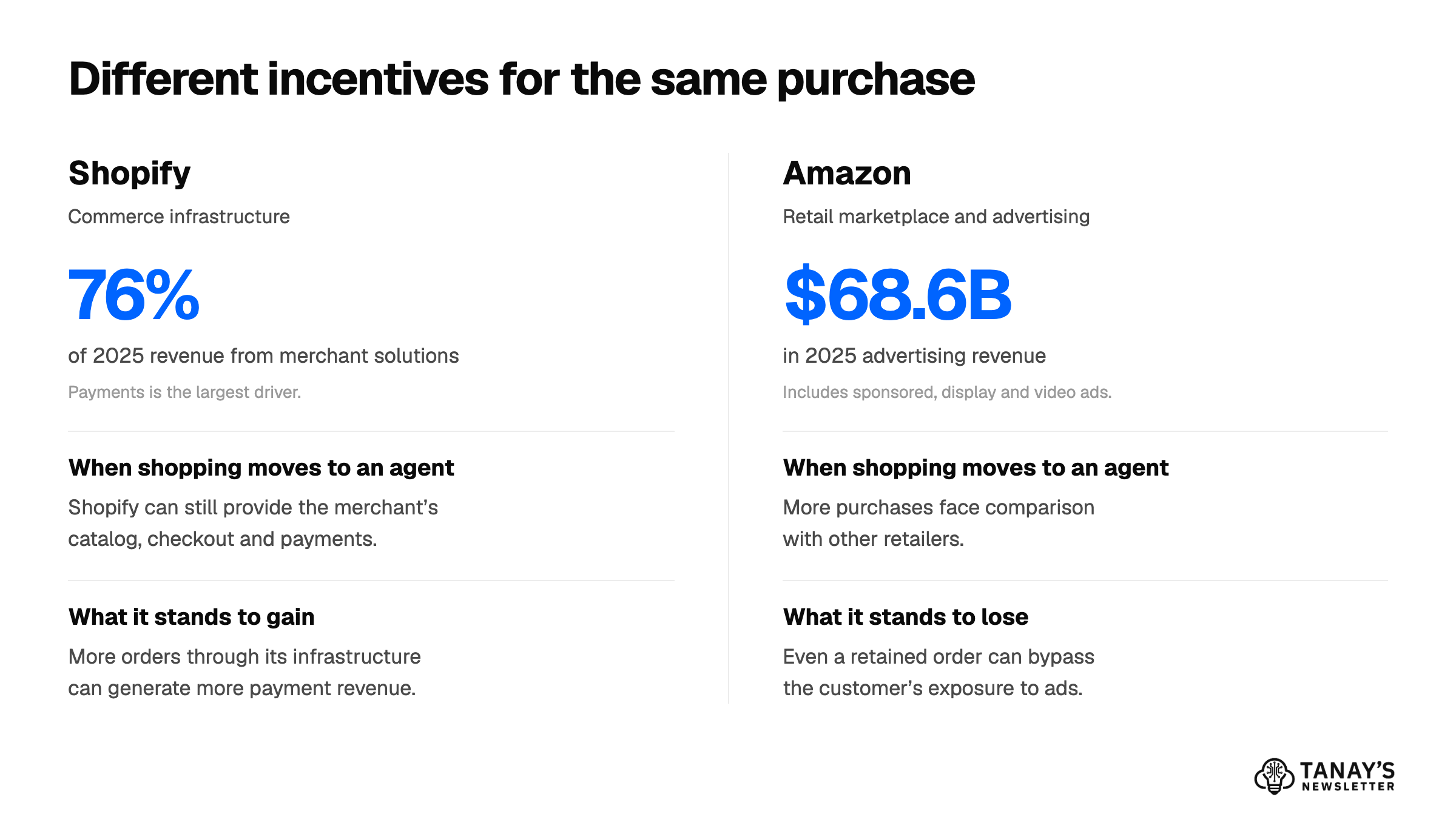
Merchant Solutions, which represents 76% of Shopify revenue, primarily driven by payments transacted on the storefronts of its Merchants.
The case for Shopify to support agentic commerce is quite simple. One, the threat of merchants not properly showing up in AI engines and AI agents with their first-party owned storefronts is driving them to move over to Shopify, which results in more subscription revenue. On their earnings call, Harley Finkelstein said the agentic plan was opening conversations with brands that wanted access to AI shopping but weren’t ready for a full migration.
Two, if Shopify merchants show up more often and are easier for agents to buy from, they could gain share in their categories. More purchases processed through Shopify would mean more payment revenue for Shopify.
Since Shopify hasn’t really been a demand aggregator of sorts (one may argue the Shop App is a slight exception), it doesn’t have as much too lose at least in the short to medium term. It doesn’t need to own every interaction leading to a purchase and can provide the catalog, checkout and payments layer.
They make it clear in their checkout documentation that merchants still pay thier standard processing fees with no additional fees. In some ways, this is the commerce version of “power the agent” that I wrote about earlier.
Amazon’s incentives
Amazon has cited agent identification and credential access as reasons for blocking Muse. While these issues are important, its clear they aren’t the whole story. Amazon has a few of its own business interests to protect.
The first is its position as the default place to shop. For a Prime member who buys everyday essentials on Amazon, comparing stores for every bottle of shampoo or pack of toilet paper may not feel worth the effort. An agent can do that work for them, making purchases that Amazon previously won by default more contested. Amazon may still win on price and fast and free shipping but it would have to compete for more of those transactions.
The second is advertising. Amazon generated roughly $69B in advertising revenue in 2025. The vast majority of that comes from sponsored products ads on its eCommerce platform, which require humans still visiting their websites and transacting the traditional way.
If an agent ends up purchasing from Amazon, they may never see the search results or sponsored listings, and so even if Amazon wins the transaction they could lose the high margin advertising revenue.
Meeting customers where their agents are
Other companies are choosing to participate and meet customers where they (and their agents) are. Additional partners announced include Walmart, Best Buy, Sephora, Instacart, Expedia and others, as well as Paypal on the payments side. Doordash has an official CLI as well that I’ve been using that is currently in a waitlist.
These companies also face some of the trade-offs. If they have an ads business, such as Doordash (which does >$1B in ads) or Walmart, this approach poses a threat to that ads business. Additionally, it makes it easier to comparison shop, which is especially tricky for companies like Expedia which don’t necessarily have unique inventory.
But the flip side is that being hard for agents to buy from could mean losing demand to companies that support them. Being early could help some retailers and marketplaces gain enough new purchases to offset part of what they lose elsewhere.
Ad Budgets in an Agentic World
I think advertising on shopping surfaces is particularly exposed if agents start doing more of the purchasing. Amazon and others can slow the shift, but if customers find these agents useful, blocking them may be difficult over time and a losing hand.
So what happens to ads and/or advertising budgets?
It helps to separate the companies paying for ads from the companies earning money from them. Brands and merchants pay to get their products considered. Retailers and marketplaces such as Amazon earn revenue by selling access to human shoppers. Agent platforms (Muse, et al) could become another place merchants pay to reach those shoppers (in agentic form).
Today, a merchant might pay a marketplace such as Amazon for a sponsored listing. If an agent is choosing for the customer, the merchant could use some of that budget to offer a lower price, free shipping or better returns. The customer gets more value, which gives the agent a reason to choose that product. In effect, some of the money that went to the platform selling the ad could go to the customer instead.
As I touched on in my earlier piece on ads in AI, Google’s Direct Offers points in this direction. Merchants can surface deals within AI mode and Google intends to expand the pilot to support more types of promotions. One possible end state could be fully delegated negotiation.
What this may also look like in practice is that instead of spending on ads, merchants could essentially offer their ad budget directly to the consumer via their agent in order to increase the consumer surplus of their product such that the agent will choose it.
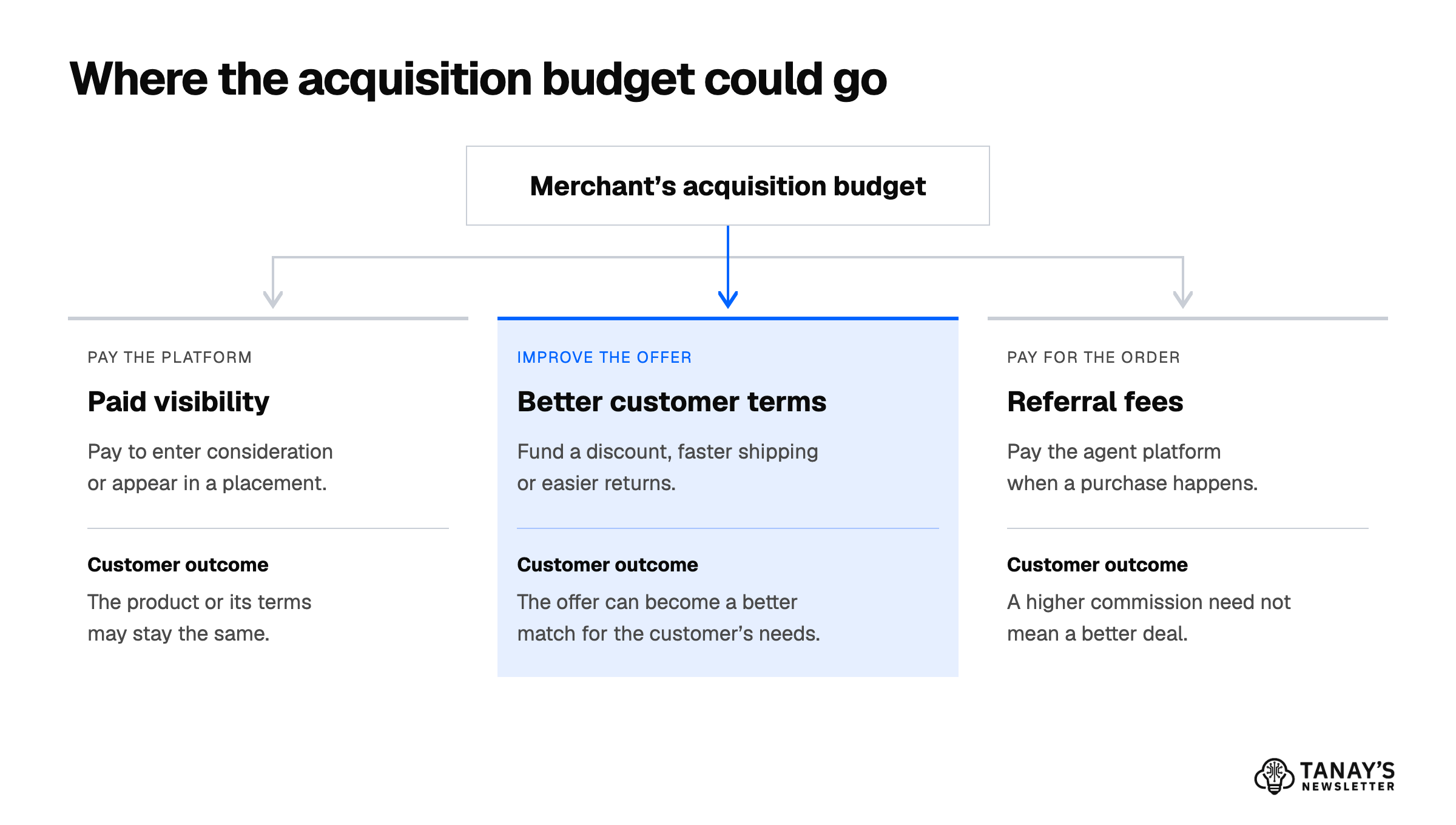
That still leaves room for paid distribution. Agents may not consider every merchant. Their catalogs, integrations and defaults (web search / model) will shape which products make the shortlist. Agent platforms could charge merchants for visibility in that shortlist, or collect referral fees when they generate a purchase. Some of the merchant’s acquisition budget could move to the agent platform. Both Mark Zuckerberg and Noah Shin have spoken about charging transaction fees as a possible monetization model.
Mark Zuckerberg noted that “over time we will profit by taking a small fee from transactions” and Noah Shinn noted that Instinct already does $1B in transaction volume, half related to travel and that he wants to explore that affiliate style model while keeping the product free to users.
Another possible scenario is around proactive purchase suggestions, which can be “ads” oriented to try to create demand for a product with the customer. If kept at some reasonable quantity, they can be viable, but Noah noted:
It would be a very dangerous world if Instinct were influencing the user’s behavior to purchase something that they don’t want
I think this idea of influence and incentives will end up being a core question. Discounts and better terms can improve the value to the customer. Paid visibility could mean an agent considers a relevant product but it can become an issue if the payment influences the final recommendation. Referral fees also create a similar tension where an agent platform might recommend a product that earns it higher fees that may not be the best for the customer.
As an aside, I also don’t think that this poses a massive threat to Meta’s Instagram/Facebook core ads product just quite yet. Ultimately, as long as users scroll those feeds, there will still be room to induce demand for new products that users may not have thought to purchase at all. But what may happen is most direct response style ads there look more like brand style ads in their goals and objectives.
Closing Thoughts
At least initially, the move to agentic commerce will help smaller agents that focus on good products and agent visibility. They get considered more often even if they aren’t a destination / brand consumers know about and would visit themselves. And products that ultimately offer high utility or consumer surplus benefit as well since they are more likely to be chosen by agents.
Shopify provided an alternative to those who wanted to own their experience and not be subject to Amazon’s whims. Long term, the risk might be if we have a few select concentrated agent platforms that a lot of this commerce gets driven through, merchants will now face the same issues.
But there’s a lot to figure out before we get to that point, including how the agent platforms make money, how the retailers adapt and navigate the threat to some of their revenue streams (sponsored listings/ads) and how merchants can influence agent behavior (organic or paid).
If you have any comments or thoughts, feel free to tweet at me.