

I’m Tanay Jaipuria, a partner at Wing and this is a weekly newsletter about the business of the technology industry. To receive Tanay’s Newsletter in your inbox, subscribe here for free:
Hi friends,
Agility Robotics is going public through a merger with Michael Klein’s Churchill Capital XI at a $2.5 billion pre-money valuation. They filed their S-4 last week and it’s the first time we get audited financials from a US humanoid company, and it pairs well with Unitree’s filing that I wrote about earlier this year.
The headline is that Agility did $1.8 million of revenue in 2025 against a $140 million operating loss. But the more interesting aspects are around the product and the business model, which I’ll cover in this piece.
In this piece, I’ll discuss:
What Agility makes
The financial picture
The business model
The technology stack
Manufacturing and vertical integration
I. What Agility Makes
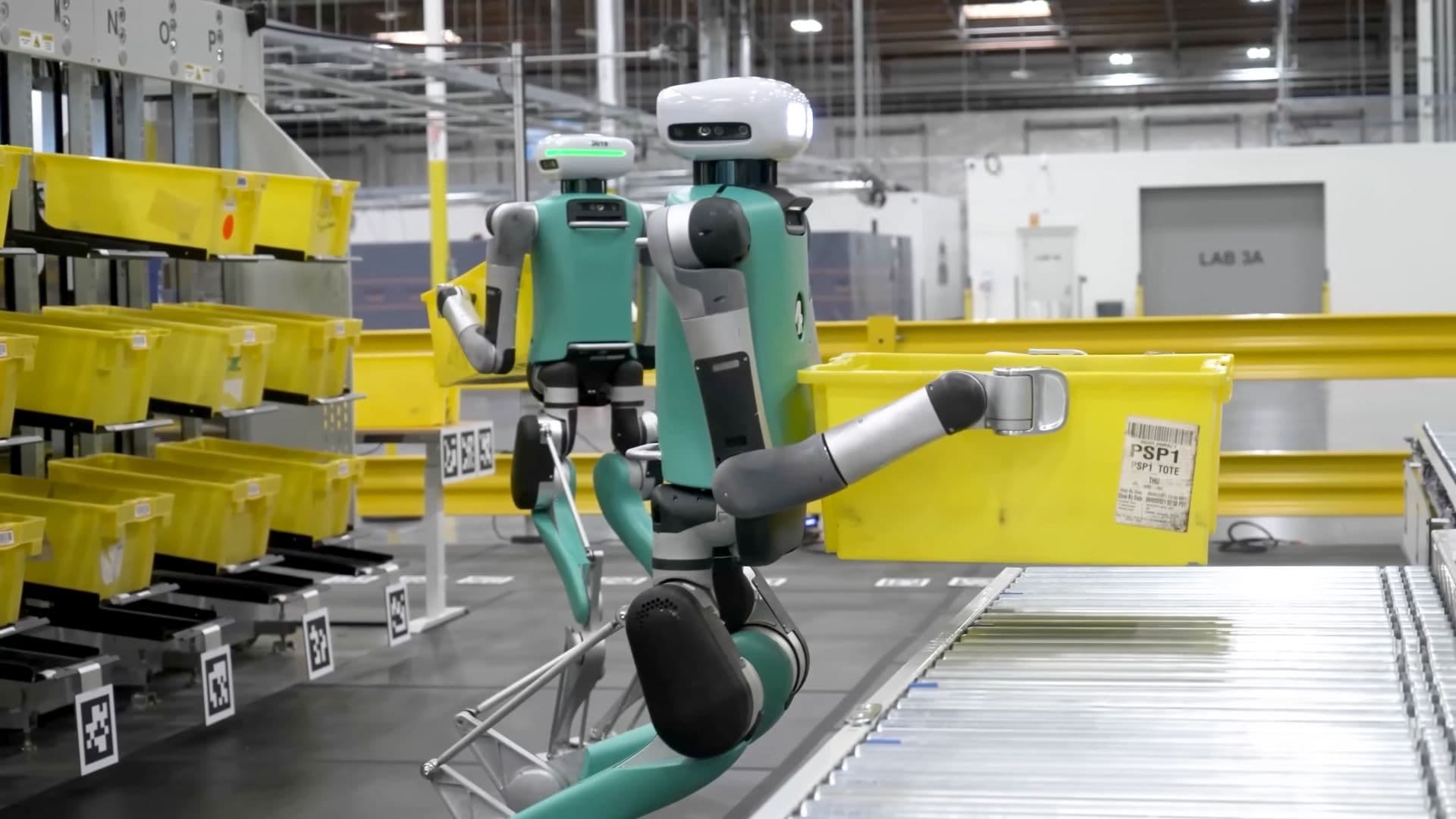
Agility started in 2015 as a spin out of Oregon State University and is based in Salem, Oregon. While the product has evolved over time, today its focus is on making a bipedal humanoid robot Digit which is currently on its 4th version with the 5th version recently announced.
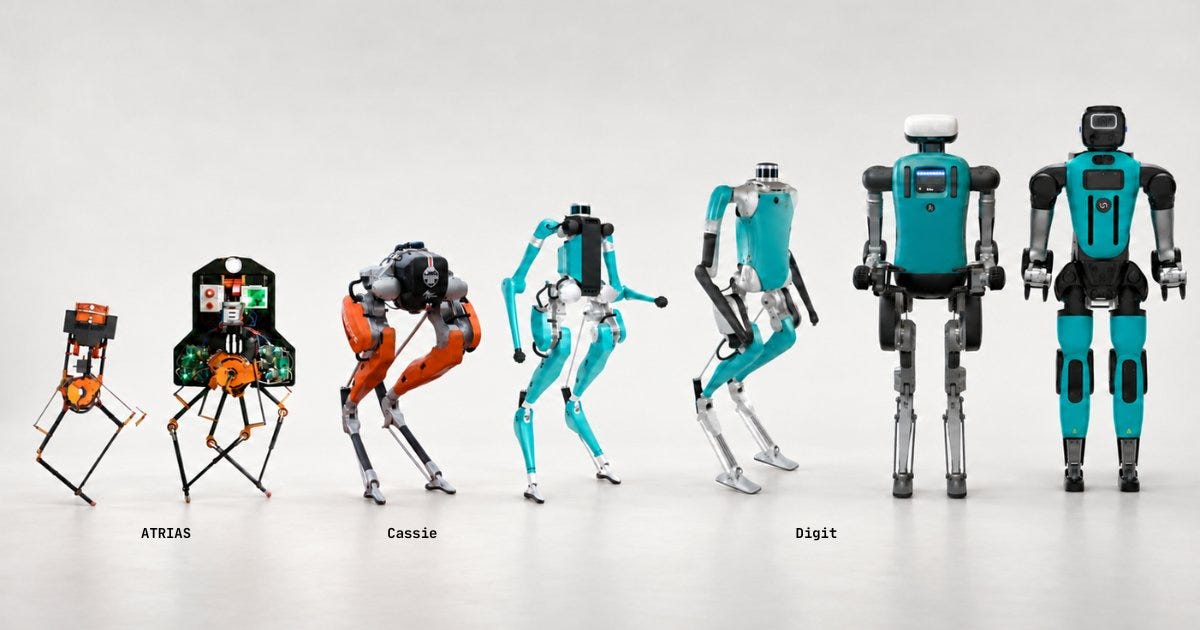
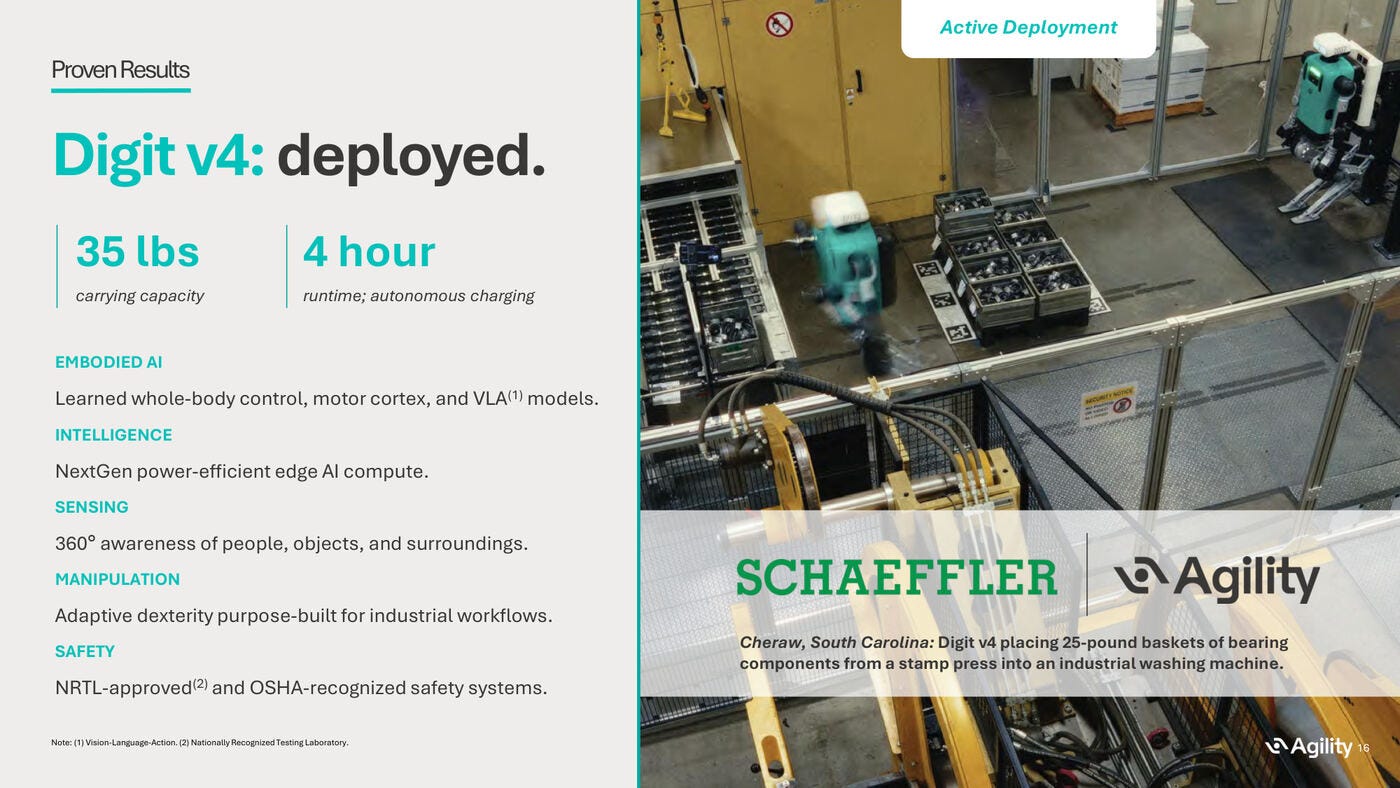
It is deployed in a few places today and can do tasks such as moving totes, feeding lines and tending machines at companies such as Amazon and Schaeffler.
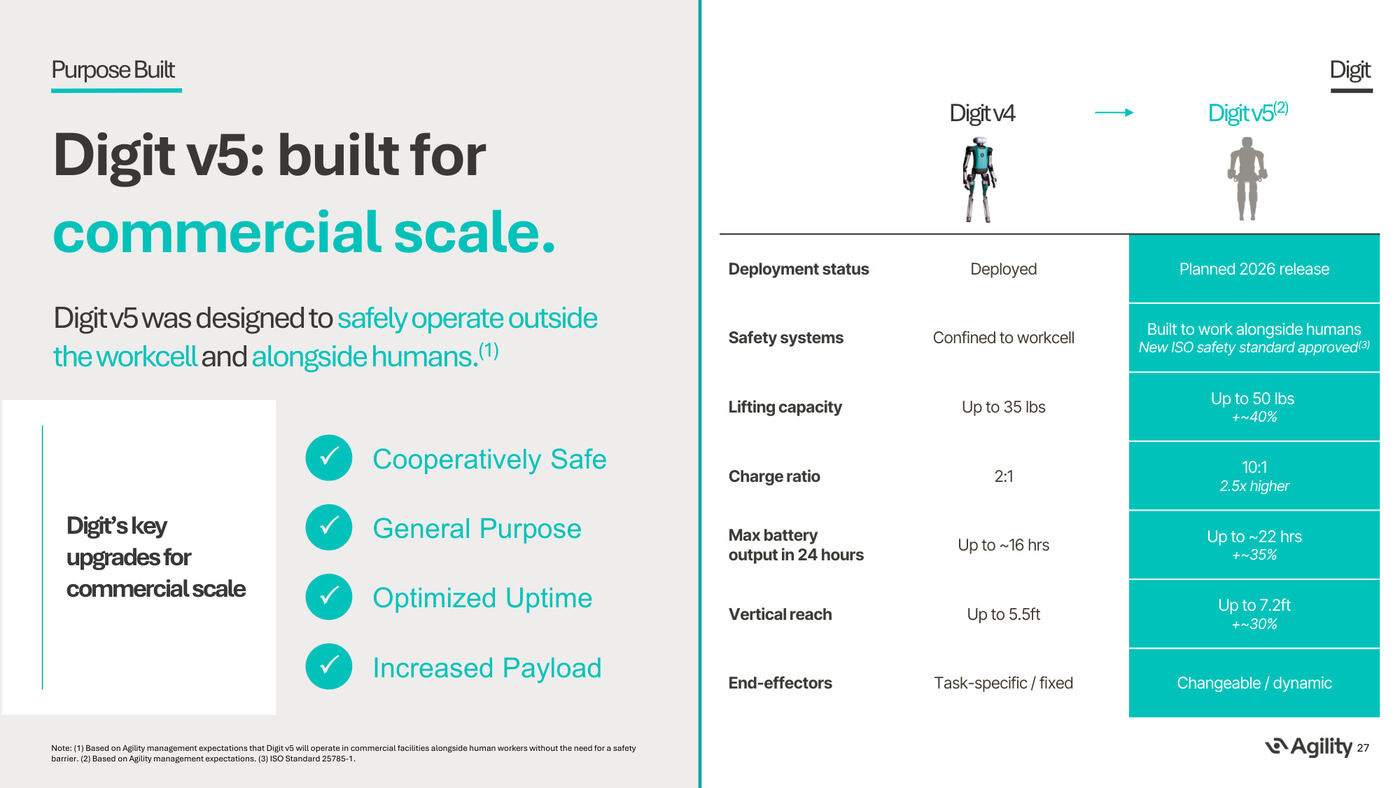
The company’s Digit v5 robot will be out later this year. Some of the key upgrades on it is that this version will be able to work alongside humans rather than in a cage/workcell. In addition, it supports fast charging, a higher payload and swappable end effectors. Digit v5 will be the primary product for the company moving forward.
II. The Current Financial Picture
Agility is still very early in its monetization and deployment journey. The company generated $310K in 2024 and $1.8M in 2025, with the majority of revenue in 2025 driven by sales of their humanoid.
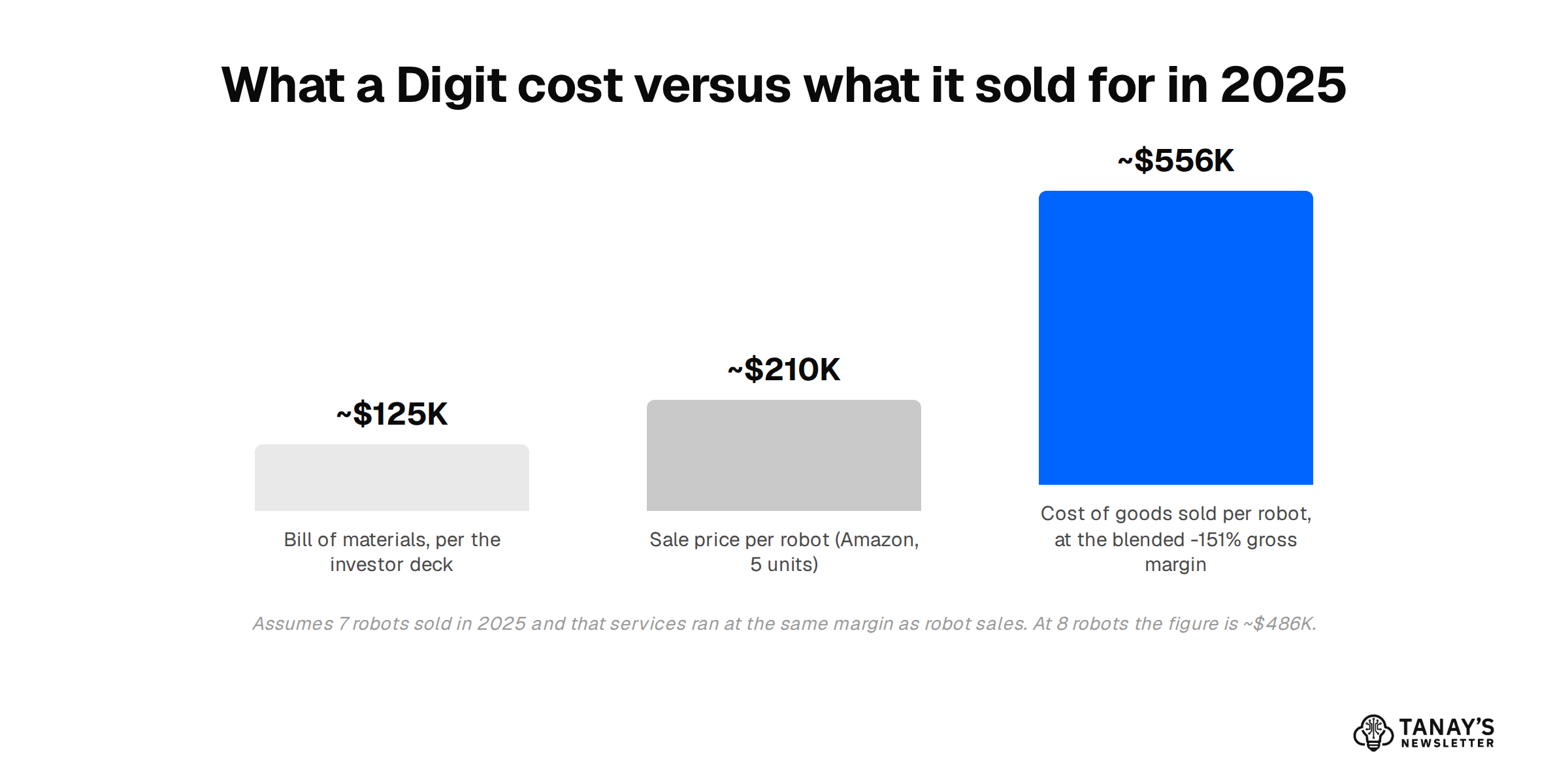
There were ~7-8 humanoids sold in 2025, 5 of which was to Amazon who is also a shareholder in the company.
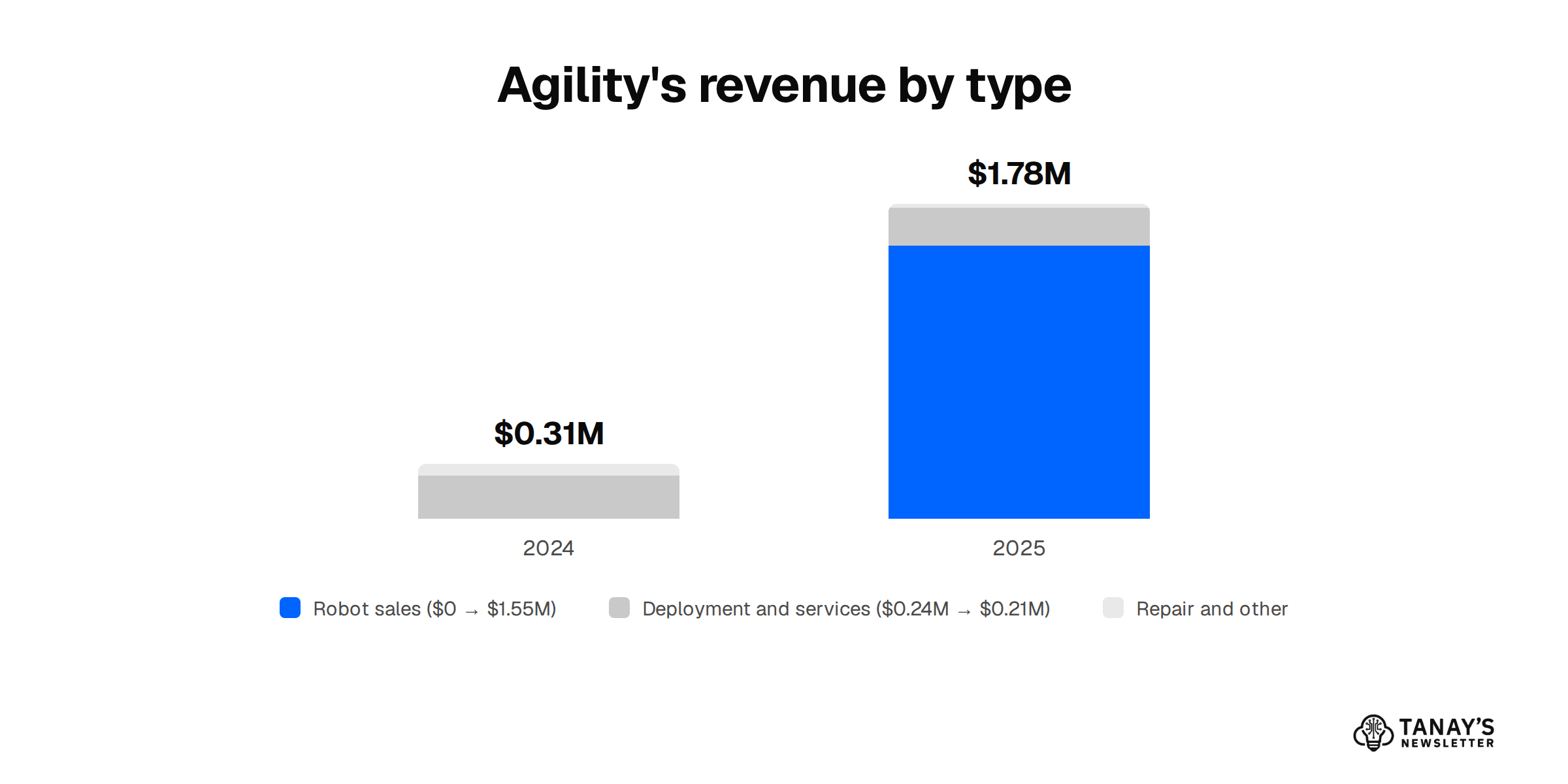
The company operates at negative gross margins (COGS in 2025 were $4.5M on $1.8M of revenue). Part of this is that manufacturing is very much subscale today.
The aggregate P&L doesn’t look great for Agility - they had operating losses of over $140M, but it also highlights just how many moving parts there are here and how difficult building a humanoid which does valuable work is.
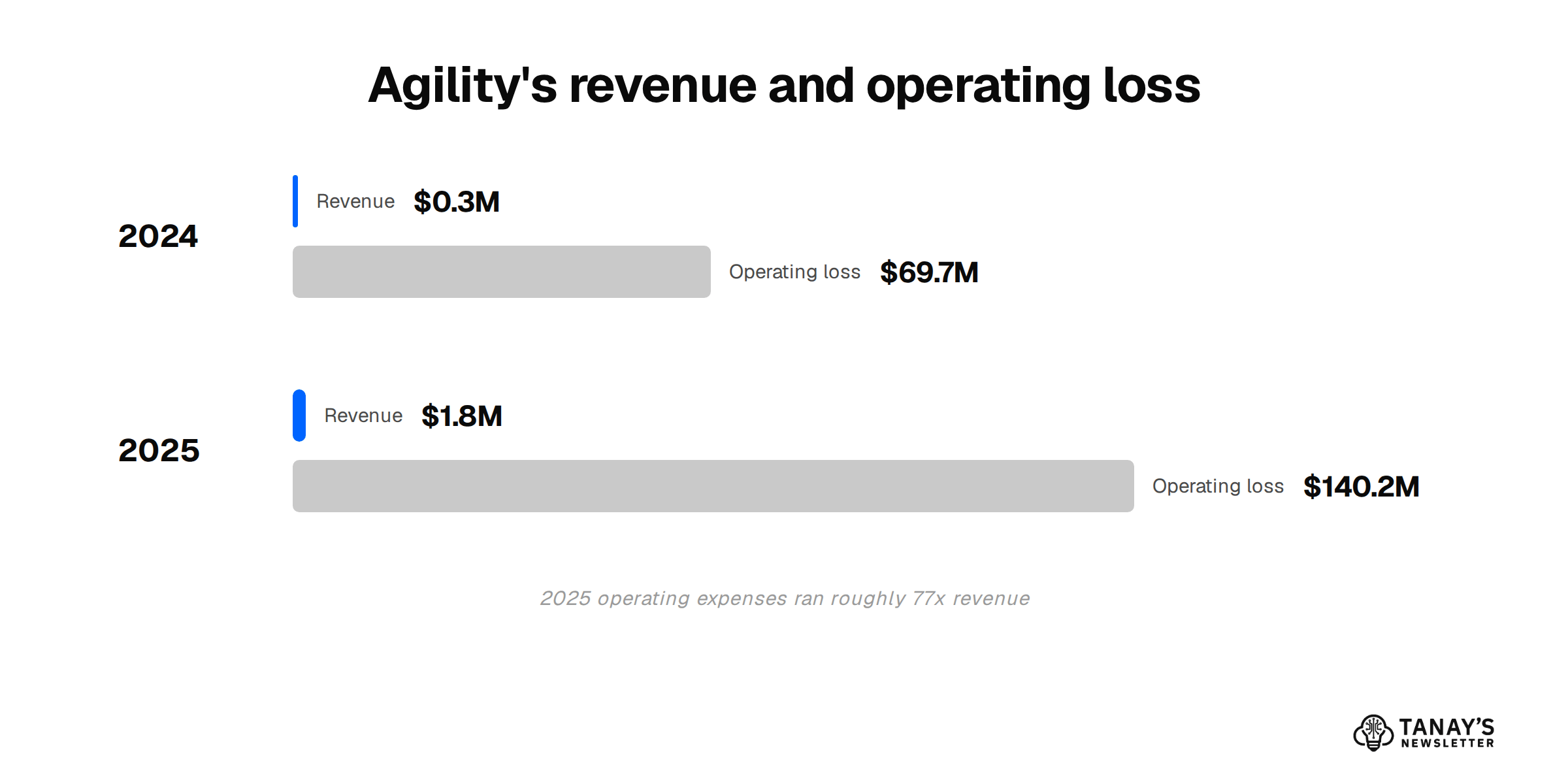
Cash was $103 million at 2025 end against roughly $100 million of annual burn, which gives you a sense that things are tight and this fundraise is critical for continued operations.
III. The Go-Forward Business Model
While the business as it exists today is selling a handful of v4 robots to strategic investors and others, the plan for the business going forward is more of a RaaS model where the v5 robots would be rented as labor.
In the RaaS model, customers will pay an illustrative $8.5K/month plus a $25K deployment fee, which works out to about ~525K/robot over a 5 year life. Customers can also choose to buy the robot upfront, in which case they pay $200K upfront and $36K/yr for software and maintenance.
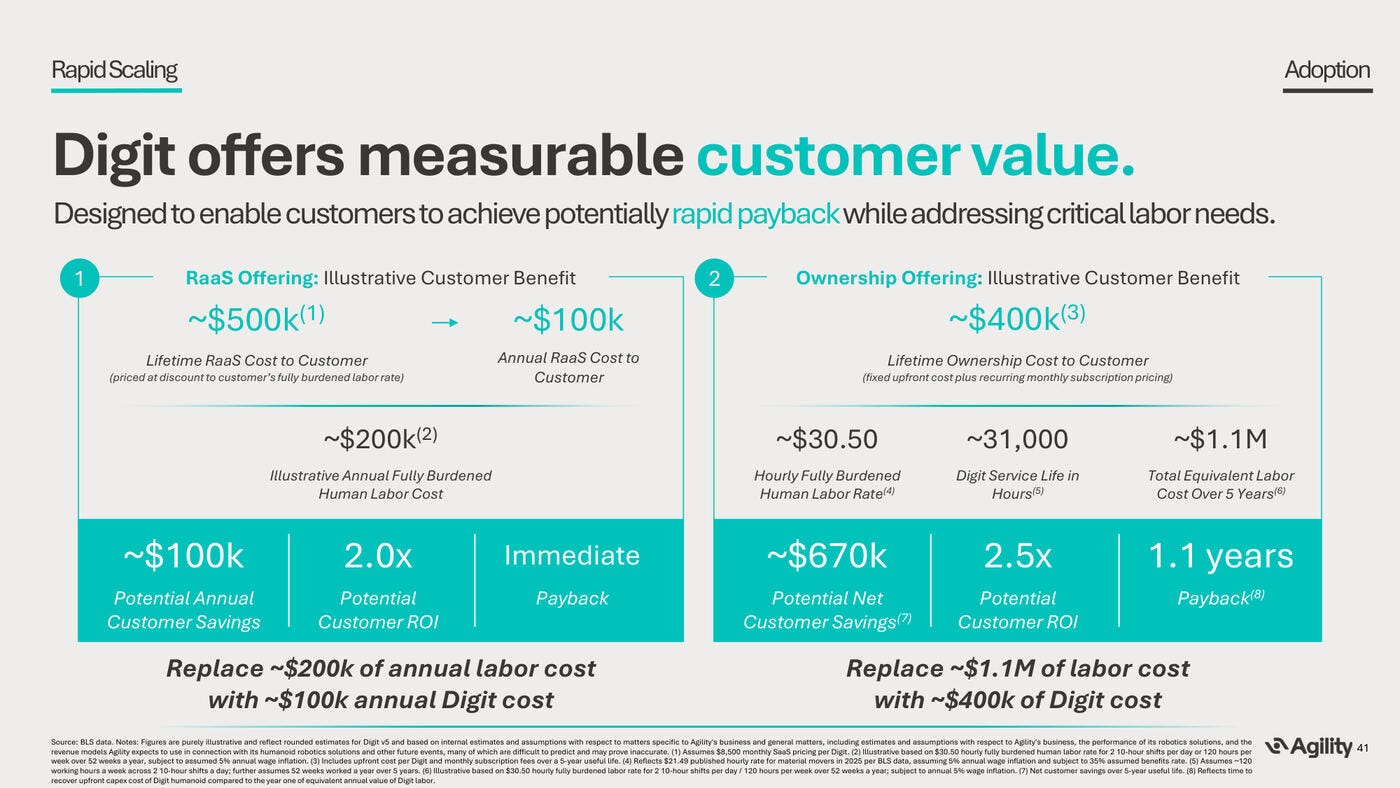
Given this model, revenue will naturally lag deployments if it takes off since it will be recognized on a recurring basis monthly.
From a pipeline perspective, Agility runs what they call a Customer Acceleration Program or CAP. Customers pay a fee of 500K to essentially go through a process of proof of technology, concept and then a pilot, after which the customers can either move to a commercial deployment or not. They have 4 customers who have opted into this in 2026. There is also one large $300M customer (who is unnamed) who has committed to 1,000 of Digit v5 robots on a 3-year RaaS contract gated on milestones. That company also has warrants in Agility that vest as robots get deployed.
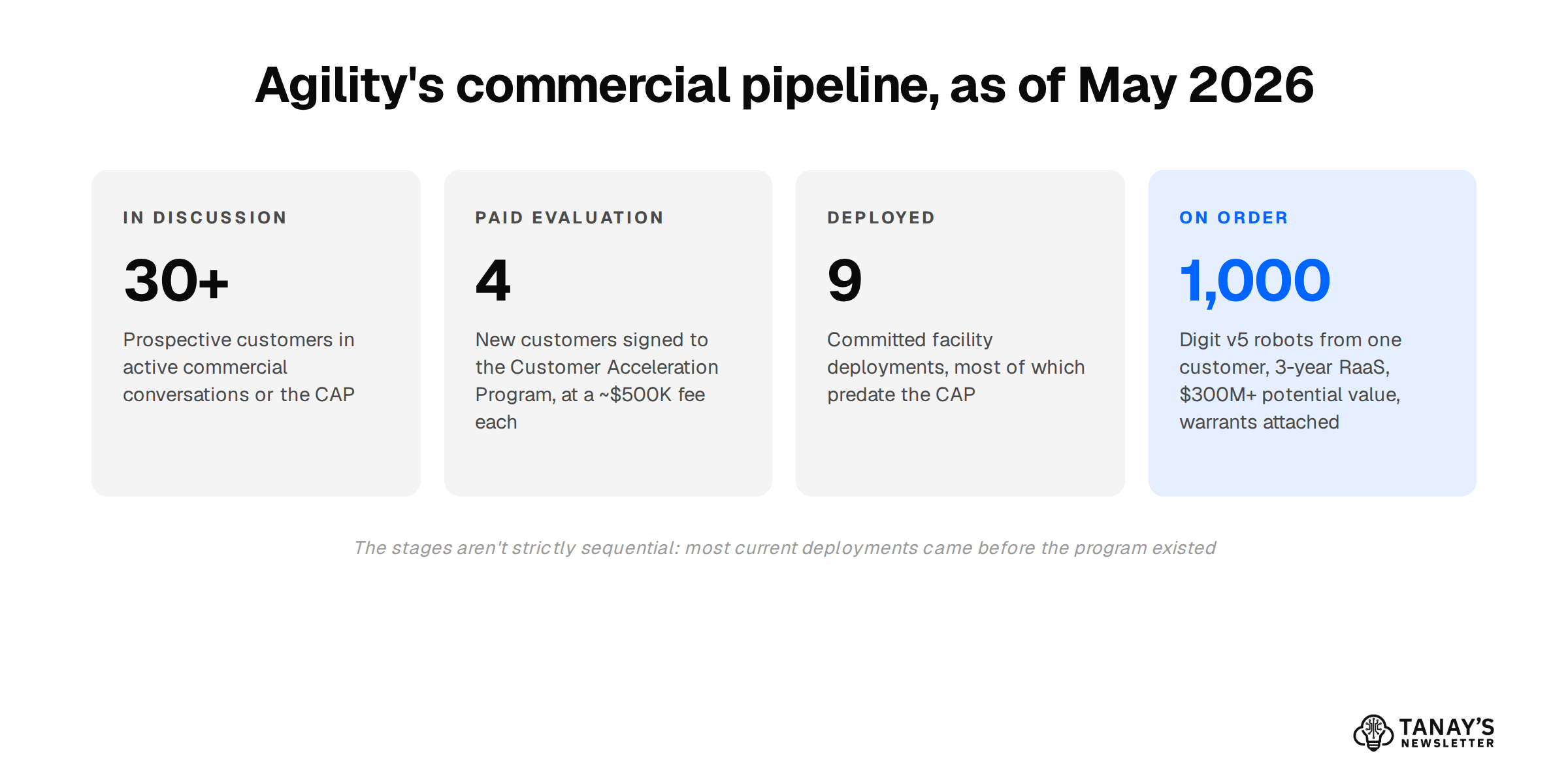
Between this customer, Schaeffler, Amazon, and Foxconn (who are leading the PIPE), the customer list and the cap table overlap a lot.
IV. The Technology Stack
In addition to the RaaS, Agility has invested across the hardware, models and software stack:
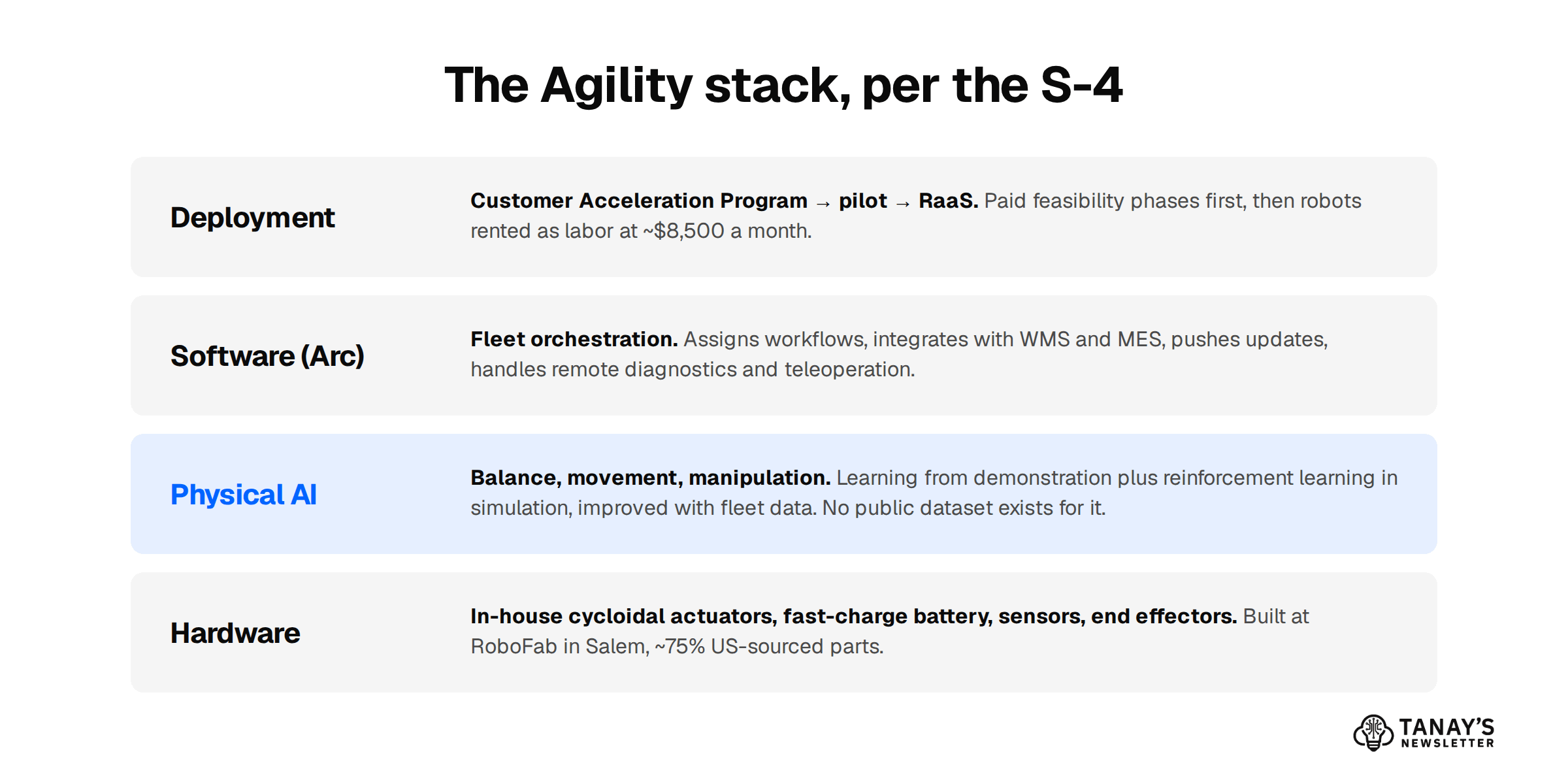
Hardware. Digit believe’s it proprietary cycloidal actuators is its single most significant differentiator, designed for repeated impacts and precise force control. Other components such as the fast-charge battery, sensor architecture, whole-body control platform and end effectors are all designed in-house. I’ll touch more on manufacturing next.
Models. Agility draws a clear line between semantic AI and physical AI. They believe semantic AI (LLMs, vision foundation models) which are trained on public data is becoming more of a commodity over time.
Digit’s approach is to focus on Physical AI models by learning from demonstration (teleoperation, motion capture data) combined with reinforcement learning in sim, and like others believe that once deployed, every hour generates proprietary data that improves the fleet. So far they have about ~65,000 hours of deployment data.
Software. Agility has a fleet orchestration layer called Arc. It can assign workflows, integrates with various systems and can also be used for teleop and diagnostics, and allows the Digit robots to feel part of the customer operations.
V. Manufacturing and Vertical Integration
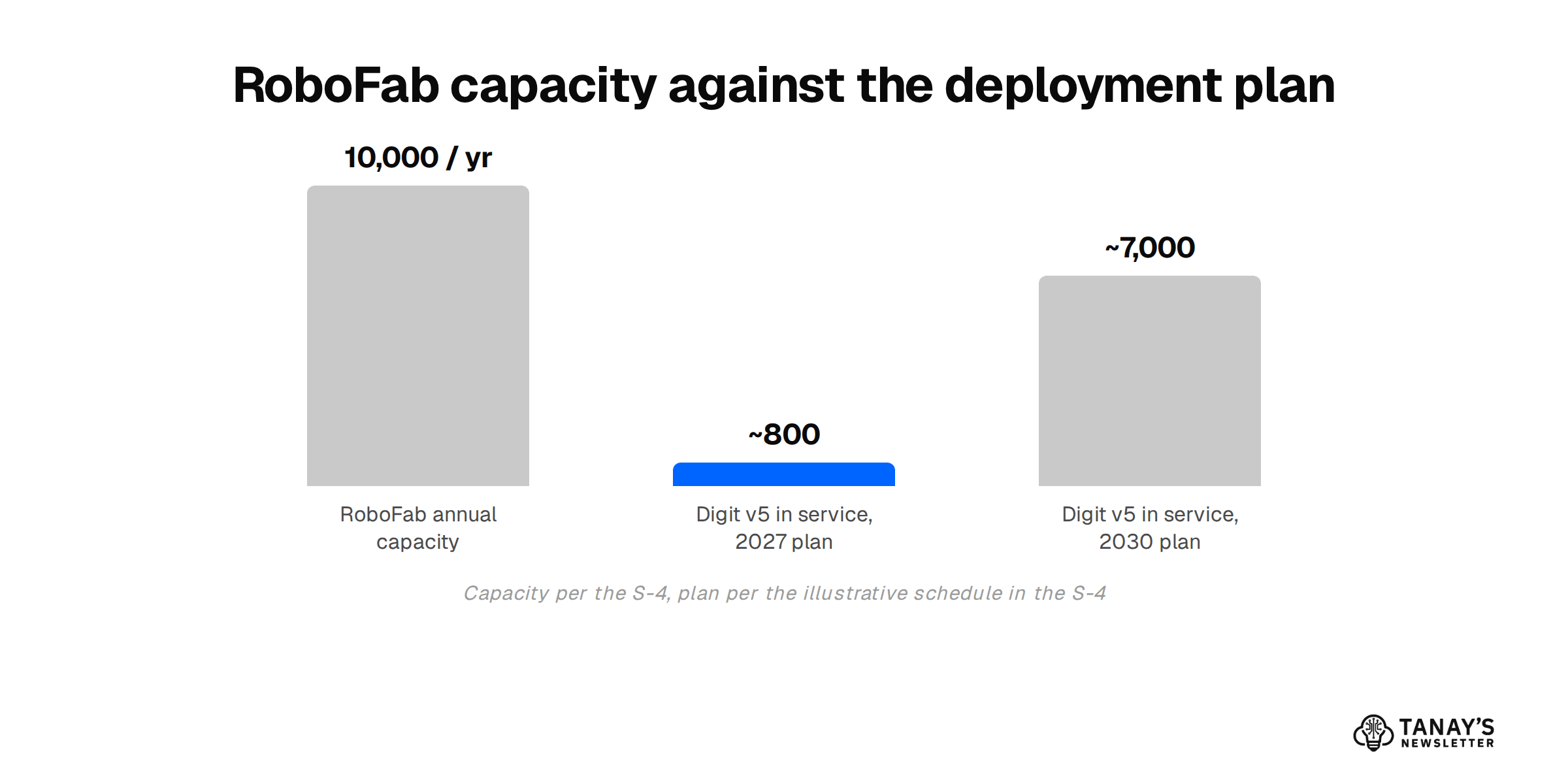
Agility builds Digit itself at its RoboFab in Salem, a 70k sqft facility designed to make up to 10,000 Digits a year. The factory is built out at the level to support many years of scaling and way ahead of demand, since their own projections call for only under 10K humanoids a year in 2030.
Agility is somewhat vertically integrated but not to the extreme. It designs and builds the systems it considers high-value (the cycloidal actuators and the manipulation architecture and end effectors among others) and buys the inputs underneath and the rest of the components: compute, sensors, alloys.
The v4 bill of materials is around $125K and the target over time is near $30K, with management aiming for the reduction to come from engineering and supplier maturation on the in-house components. Aggregate COGS is very negative and would imply a very high COGS per Digit today of over 500K.
VI. Closing Thoughts
Agility has some very interesting pieces: some early but real deployments, customers who pay for pilots, a factory and in-house actuators and a manufacturing facility. But what the filing clearly shows how early things are. It made barely $2M in revenue at very negative gross margins with most of the customers being investors in the business.
The key question for the business will be about the Digit v5 launch and whether their RaaS offering takes off over the next year with real deployments that start to scale.
If you’re building in the robotics and embodied AI space, feel free to reach out at tanay at wing.vc.