

I’m Tanay Jaipuria, a partner at Wing and this is a weekly newsletter about the business of the technology industry. To receive Tanay’s Newsletter in your inbox, subscribe here for free:
Hi friends,
Earlier this year we saw both OpenAI and Anthropic start deployment companies, or DeployCos, for short. Essentially, these are entities whose job it is to embed engineers inside enterprises to help them adopt AI agents and get them working in actual workflows. In addition to the model labs, we’ve also seen hyperscalers also really lean into forward-deployed motions. At the same time, companies like Palantir and Accenture have continued to see continued momentum doing this work.
In this piece, I’ll talk about the lab’s DeployCos, why we’re seeing the rise of these DeployCos and what the playbook and landscape looks like.
The Lab’s DeployCos
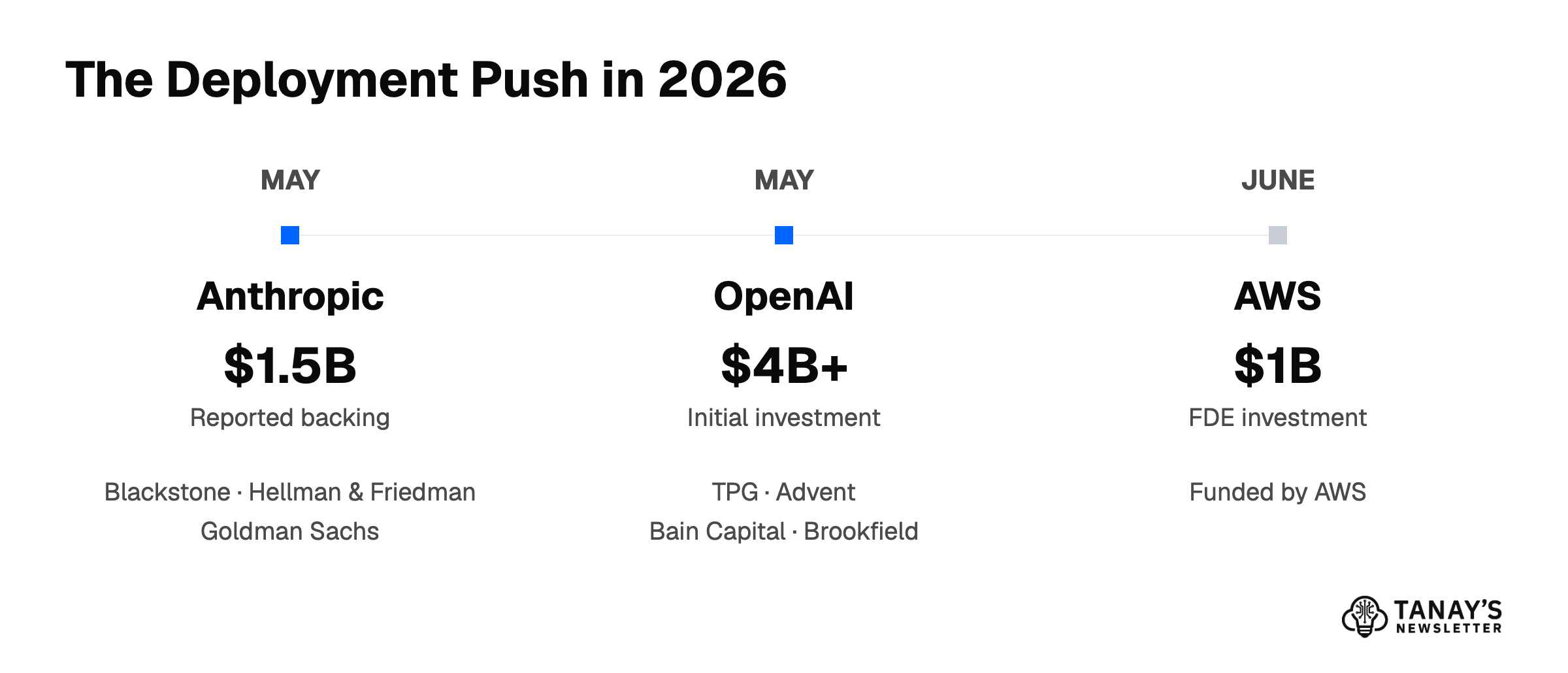
First, it’s worth touching on the labs’ own DeployCos. Anthropic announced theirs in May, which is a $1.5 billion AI services firm set up with Blackstone, Hellman and Friedman, and Goldman Sachs, as well as other private equity firms. It launched in July as Ode with Anthropic and was built on an acquisition of Fractional AI. It’s aimed at midsize companies, starting with the private equity sponsors’ own portfolio companies.
OpenAI then announced the OpenAI deployment company, which raised over $4 billion, led by TPG. It’s majority-owned by OpenAI. OpenAI also acquired a firm, Tomoro, to get it off the ground, starting with 100+ FDEs on day one.
They are both quite similar. They have a separately capitalized entity and an acquired Applied AI/services firm as the core team, some of the labs’ own engineers inside of it, and the private equity sponsors’ portfolios as the initial customers.
The hyperscalers are running a version of the same play as well. AWS committed $1 billion to a forward-deployed engineering unit at the end of June.
Why We’re Seeing the Rise of DeployCos
AI is so powerful and magical so why are we actually even seeing these DeployCos? I think there are two primary reasons that are applicable broadly and then there are a few additional reasons that the labs in particular have started their own.
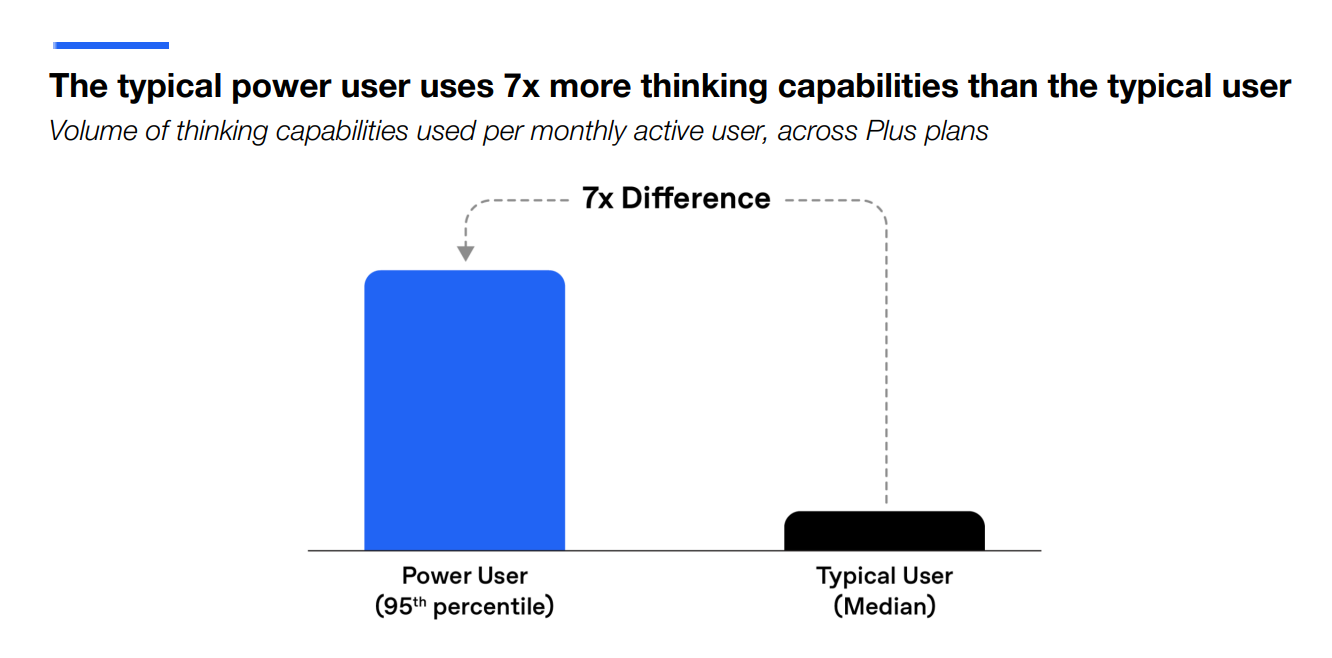
I think the first is the diffusion gap that Pat Grady touched on. These models can do a lot of valuable work, much more than they’re currently being used for. People often also use the term “capability overhang” to talk about how the capabilities that these models have are much further and broader than what they are being put to use for by most people, which OpenAI even tried to quantify on a user level in the chart below. DeployCos are one way to address this diffusion gap and capability overhang.
The best evidence for this is probably OpenAI’s GDPval, which takes real work products across many different knowledge work occupations and has experts grade model outputs. Models can do over half the tasks better than the experts on the tasks, but most organizations are nowhere close to leveraging AI at that level.
The second reason is culture and organization alignment. Putting AI into practice isn’t as simple as just letting the models loose. You need to get access to the right systems. You potentially need to redesign the workflows. You need get buy in across the org. You need to change the way people do work. These are things that cut across teams and organizations, and it’s not necessarily any individual’s specific job.
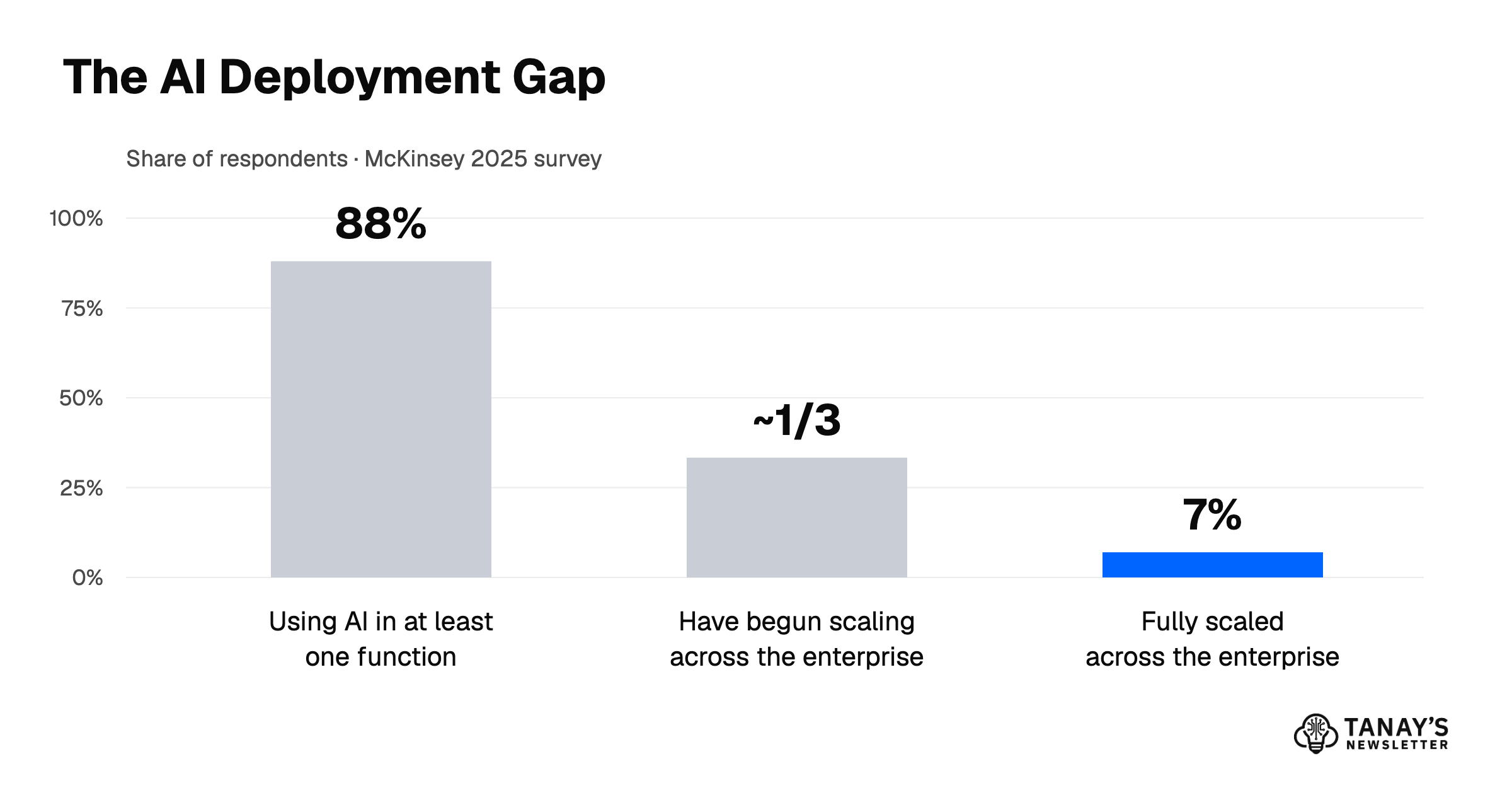
AI obviously doesn’t solve these problems automatically and cannot figure out org alignment, incentives, and trust itself. This is a big part of why there’s a booming demand for good old consultants (branded differently) to come in to solve these things.
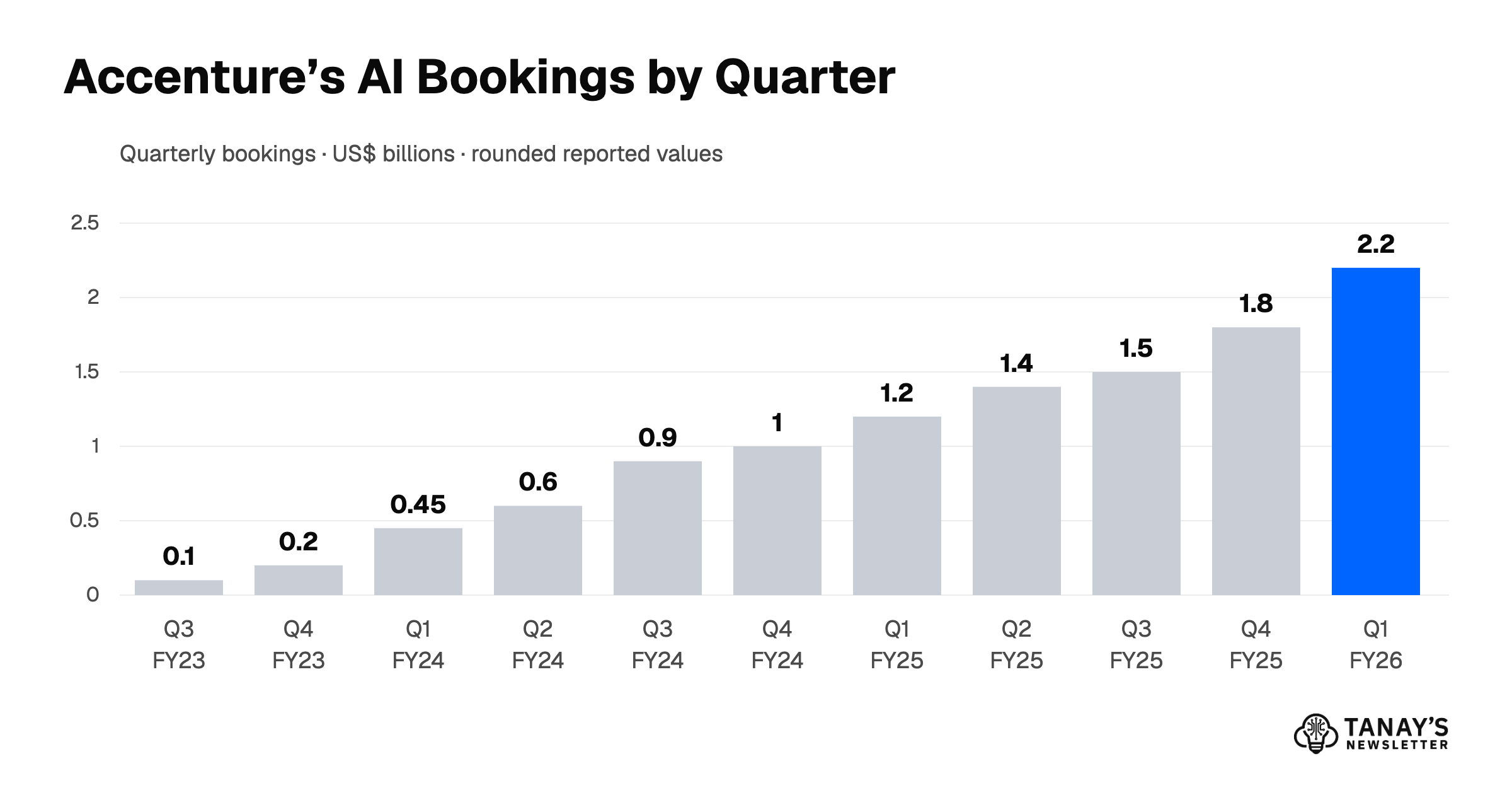
This is quite clear when looking at the demand for services for some of the incumbents. Accenture has booked about $11.5 billion of generative AI work over the last three years.
Palantir, which arguably pioneered the forward-deployed engineer over a decade ago, has accelerated revenue growth every quarter for the last 12 quarters. CTO Shyam Sankar quipped on a recent earnings call:
“Remember, only Palantir has FDEs. Everyone else has sparkling sales engineers.”
There are also a couple of secondary reasons for the labs starting DeployCos:
One is that deployment work generates long-horizon traces of how real work gets done across industries, which is valuable either as training data directly or just as insight to help labs know where to focus their model hillclimbing efforts.
Second is that model performance across the labs is relatively close, particularly for most enterprise workflows. Being the one embedded to actually deploy agents for a customer’s workflows creates a version of lock-in versus other model vendors.
Lastly, from a TAM perspective, building and deploying agents allows you to potentially charge for the real outcomes you deliver and so earn, justify, and generate more revenue than just tokens might by themselves.
Types of DeployCos
The DeployCos mostly run a similar playbook. FDEs will embed with the customer and start with a few higher-value workflows, where ideally the tasks are somewhat bounded and the outputs can be checked and verified.
They’ll understand the workflow, build a agent harness that wires the model into a company’s data and other systems, build evals as needed, and iterate on and deploy the agents once they clear some quality bar. Ideally, they will also build a learning loop such that it can get better in production.
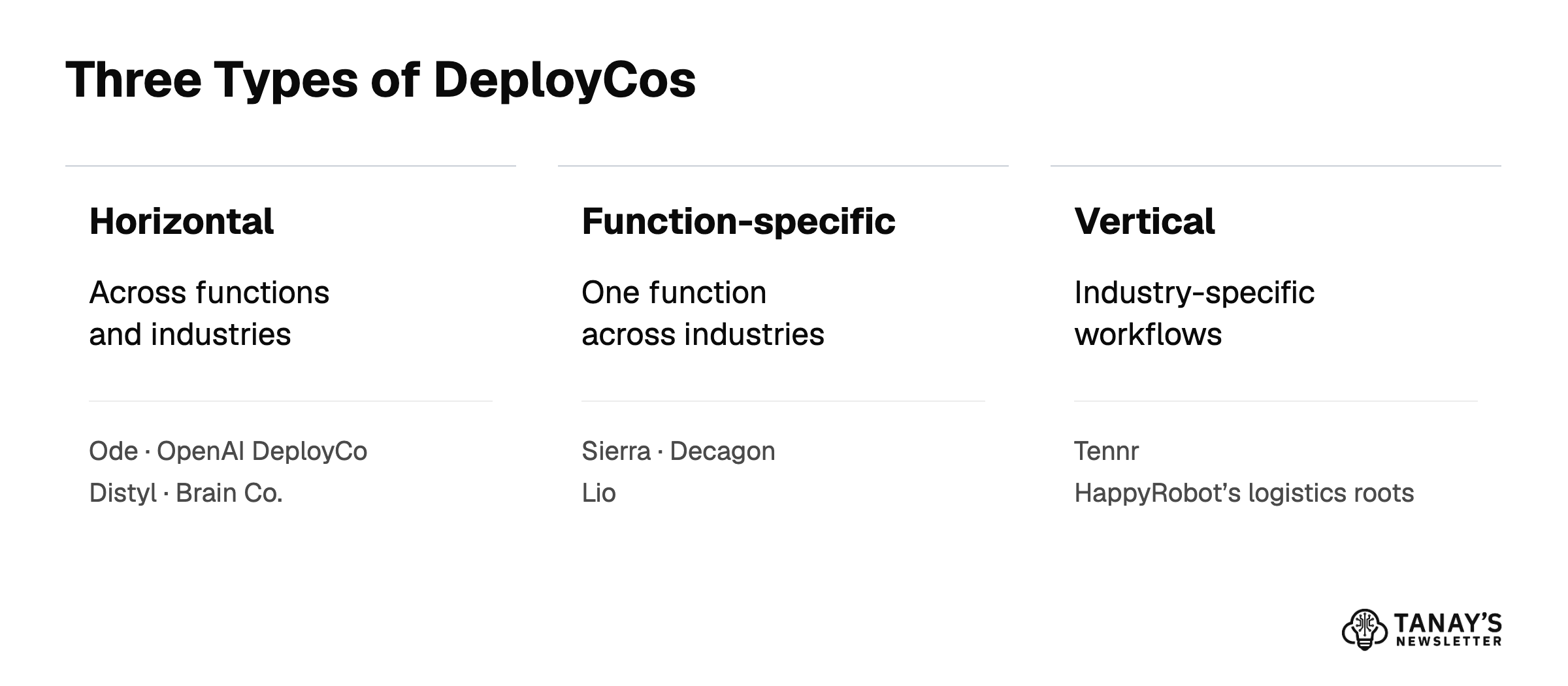
Incumbents like Palantir and Accenture (and other consultancies and SIs) have been doing versions of this work for years and are one form of choice for these large enterprises. Broadly, the new forms of AI DeployCos fall into three types:
Horizontal: Companies that are helping deploy AI across a wide variety of functions and industries, like the labs ventures, and others like Distyl and BrainCo. They have built some shared platforms and modules on top of which they build and deploy agents.
Function-specific: These aim to be the trusted vendor for a specific function for companies across industries. Sierra and Decagon in customer support are one example (although those are branching out further) as well as Lio in procurement.
Vertical-specific: These are companies trying to bring AI agents to enterprises within a specific industry. Tennr in healthcare and Happyrobot in Logistics are a few examples.
Under the hood, many of the function-specific and vertical-specific ones look quite similar. They’ve built a core system for some of the common workflows in their industry or function, but there’s a lot of last-mile work to be done to get it running inside each customer. They split their team between the people building the system and people deploying agents into customers who generally have titles such as agent deployment, forward deployed engineers, or deployment strategists.
One dirty secret is that many vertical AI application companies that sell to larger enterprises are actually also arguably DeployCos. They tend to do heavy FDE work because the workflows they support are very custom, there’s a lot of bespoke integrations and custom evals needed and a lot of change management in processes to actually get into production.
Closing Thoughts
The models are clearly good enough now and DeployCos are one of the primary ways in which we will be able to take those models and put them to work to drive real ROI within enterprises and close the diffusion gap.
Another approach being taken, which is worth its own piece, is the AI-native rollup approach: to buy the businesses and then infuse AI from within. Long Lake, which just closed its take-private of Amex GBT for $6.3B, and Sequence, which just took the insurance broker Baldwin private for $7.7B, are two companies taking this approach. For them, owning the asset allows them to potentially redesign processes as needed, infuse AI from within, and then capture all the upside from AI directly. However, it ends up being more capital-intensive and harder to scale.
If you have any comments or thoughts, feel free to email or DM me.