

I’m Tanay Jaipuria, a partner at Wing and this is a weekly newsletter about the business of the technology industry. To receive Tanay’s Newsletter in your inbox, subscribe here for free:
Hi friends,
We’re currently in the SaaSpocalypse. People believe software is dead and margins will compress to zero. Some are even saying that companies like Visa get bypassed and DoorDash gets aggregated away in the age of AI. Everything that looks like software becomes a commodity and no moats remain.

Before we declare the end of defensibility of all businesses, I think it’s worth grounding ourselves in the actual sources of defensibility that exist. My favourite book around defensibility and moats is Hamilton Helmer’s 7 Powers which outlines the common ways companies build defensibility.
The question is: In an AI world, which sources of power weaken, and which survive? Let’s walk through all seven, particularly in the context of software and technology companies.
1. Scale Economies
What it is
Scale Economies exist when larger volume reduces unit cost in a way smaller competitors simply cannot match, creating a cost advantage.
In traditional software and digital businesses, scale allowed for spreading investments in engineering, infrastructure, and sales across a large customer base, creating structurally lower cost per unit.
For example:
Amazon Web Services spreads massive capital investments in data centers and infrastructure across millions of customers
Netflix amortizes its 10B+ content budgets across over 200+ million subscribers, allowing it to have more volume of content and more niche content that competitors.
Large SaaS vendors like Salesforce historically spread R&D and support costs across thousands of enterprise customers, reinforcing margin and reinvestment advantages.
What AI does
AI compresses labor-based scale advantages in software / digital work. A 20-person team equipped with agents can now build features, handle support, write documentation, and run experiments at a velocity that previously required much larger organizations.
However, at the infrastructure and model layer, scale continues to be important and a source of power.
Net result
Application-layer scale advantages that were based on spreading R&D and similar costs that across large user bases weakens.
Infrastructure-layer scale advantages still remain. In fact, Scale economies provide a source of power for model layer companies like OpenAI and Anthropic.
2. Network Economies
What it is
Network Economies arise when a product becomes more valuable as more participants join. There are two primary types:
Same-sided network effects, where users benefit directly from other users being present as is the case on social networks and messaging apps.
Cross-sided networks, where two distinct user groups create mutual value as is common in marketplaces like Uber and Doordash.
For example:
WhatsApp became indispensable because every additional user increased the utility of the network for everyone else.
DoorDash strengthened as more restaurants joined, which attracted more consumers, which in turn attracted more restaurants, reinforcing marketplace liquidity.
In each case, value scaled with growth of the network.
What AI does
Agents introduce frictionless multi-homing and can make it easier to simulate aggregating one side of a marketplace even if they didn’t exist. For example, a new food ordering service could use voice agents to call a restaurant not on their platform to order from them. Or a consumer-facing agent can arbitrage across marketplaces to find the best price.
That can weaken shallow exclusivity.
But AI cannot fabricate real-time liquidity, courier density, reputation history, or a canonical identity graph. Marketplace density and trust are structural, not labor-based.
Net result
Some surface-level network effects can weaken but deep liquidity networks with trust, reputation, and coordination density can still remain durable.
3. Counter-Positioning
What it is
Counter-Positioning occurs when a new entrant adopts a business model that incumbents cannot replicate without damaging their existing business. This often happens during technological shifts where new entrants “turn” the incumbents existing assets and business into a weakness.
For instance:
Netflix’s transition from DVDs to streaming undercut traditional rental economics and forced incumbents into painful strategic trade-offs.
SaaS companies offering subscription pricing challenged on-prem vendors reliant on upfront license revenue.
What AI does
AI creates new waves of counter-positioning. Startups can offer forms of usage outcome-based pricing instead of per-seat pricing. They can replace workflows with agents rather than augment users.
Incumbents may struggle to adopt these models because doing so cannibalizes existing revenue streams or disrupts organizational incentives.
Net result
Counter-Positioning is a powerful form of power for startups to get going in this current market. However, incumbents are more savvy than ever before and recognize that cannibalization remains needed.
In addition, startups may not be able to counterposition against all players vying to capture the new market such as AI labs, etc who are not tied to prior business models like incumbents.
In aggregate, counter-positioning remains a good source of power early on to get going.
4. Switching Costs
What it is
Switching Costs arise when customers face meaningful pain in leaving a product. In enterprise software, this historically included:
Complex data migrations
Rebuilding custom integrations
Retraining teams on new workflows and systems/UI
It was arguably the primary source of power many software companies seeked to create.
For example:
Salesforce embeds itself deeply into sales processes, capturing years and years of data, making migration costly and risky.
Workday runs payroll and HR compliance systems that are tightly integrated into regulatory reporting.
What AI does
AI directly attacks labor-based switching costs. Agents can map schemas, rewrite integrations, generate training materials, and even run systems in parallel to reduce migration risk. What once required months of consultants may compress to weeks of automated orchestration.
In addition, if agents do the workflows, human workflows may not be as relevant and human AIs may evolve to simpler natural language or change regardless, meaning that workflow as a switching cost may also drastically reduce.
Net result
Switching costs for software businesses weaken meaningfully. Companies can more easily adopt new software, get their data in, customize UIs bespoke to their workflows quickly and relatively cheaply.
Some levels of risk remain as a source of friction that retains some level of switching costs, but most companies will no longer feel held hostage by vendors.
If you don’t yet receive Tanay’s newsletter in your email inbox, please join the 10,000+ subscribers who do:
5. Branding
What it is
Brand reduces evaluation cost. It acts as a shortcut for trust, quality, and reliability.
In enterprise markets, brand often signaled safety. No one got fired for choosing IBM or Microsoft. In consumer markets, brand shaped preference and habit in a noisy world full of unclear claims.
Examples include:
Microsoft, whose enterprise brand reduces procurement friction across software categories.
Consumer brands like Nike, where emotional attachment drives durable preference.
What AI does
If agents continuously benchmark products on performance and cost and can do deep research based on individual needs of users/businesses, brand as a heuristic shortcut weakens. Evaluation can become systematic rather than reputational. This may be particularly true for consumer brands where performance and functionality matter more and brand was a shortcut for that than say brands perceived as luxury.
At the same time, AI also introduces new forms of risk: model unpredictability, hallucinations, security concerns. In high-liability contexts, institutional trust becomes more valuable.
This leads to the notion of brand splitting:
The strength of marketing-driven brand compresses in areas where price/performance tradeoffs matters and agents can thoroughly evaluate that
Institutional reliability brand persists and may even strengthen in a world where stakes remain high and risks associated with AI could even increase.
Net result
Some forms of brand weaken significantly since deep and thorough evaluations become possible, even for purchases where they didn’t make sense prior.
Other forms of brands persist or even strengthen as trust and accountability become even more important.
6. Cornered Resource
What it is
Cornered Resource exists when a company controls an asset that competitors cannot access.
This may include exclusive data, regulatory licenses, distribution control, or proprietary intellectual property such as patents in biotech/pharma. In software, the most common form of cornered resource has been proprietary data often collected and aggregated via customers directly over long periods of time.
Examples include:
S&P Global / Moody’s / Fitch have cornered resources in the form of credit ratings, indices, and reference data that are written directly into regulations, covenants, and mandates
CoStar in commercial real estate has a hard‑won proprietary dataset of listings, comps, historical deals, building attributes, and contacts that brokers and landlords rely on
Helmer uses the example of Pixar which had a once-in-a-generation cluster of creative talent as a cornered resource
What AI does
AI increases the value of proprietary data because models improve with exclusive signal. At the same time, especially for datasets that were public in some form, AI means that they are no longer “cornered” since they can now be acquired much more cheaply than in the past by leveraging LLMs to scrape / structure those datasets.
So if exclusivity is real and structural, AI strengthens this power. But for some companies that thought they had proprietary data (e.g., data businesses where data was available online) which were not truly proprietary, it shines a light on them not having as much defensibility as they thought.
Net result
True forms of Cornered Resource becomes even more important in an AI-native world. Proprietary data (or rails) and what is enabled with that increases.
7. Process Power
What it is
Process Power arises from deeply embedded organizational routines that compound over time giving companies a durable advantage over in areas such as speed, product quality, cost advantages, etc.
For example:
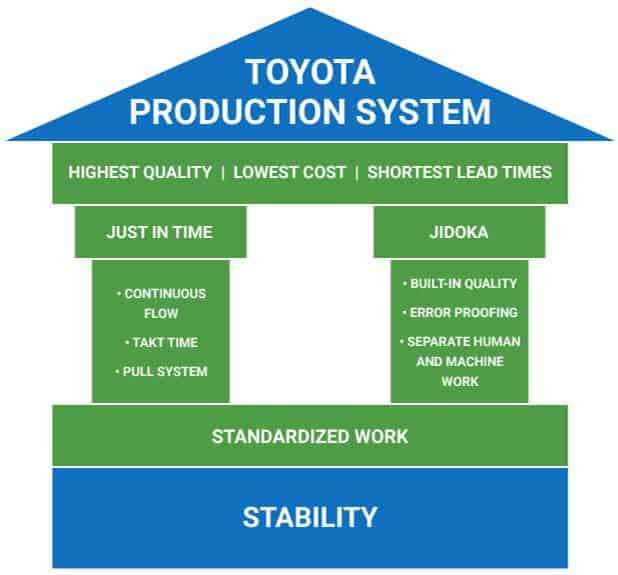
Toyota’s Production System is the prototypical examples that allowed allowed them to have manufacturing lines that improved continuously and produced cars at extremely low defect rates.
Netflix’s data-driven commissioning process allows it to greenlight content with confidence.
Meta’s large scale product experimentation and growth process that allows for continuous improvement of their products for the metrics they care about via large scale experimentation and A/B testing that was iterated on over a decade.

These routines create compounding advantage and provide a source of differentiation over others.
What AI does
AI commoditizes some forms of process advantages that happen in the digital world (product development, etc) because it allows companies to iterate faster than before and allow agents to iterate on their behalf (which arguably have best practices and experience in them via training).
However, data that is proprietary to a company does not become available to competitors, so any source of process power that depends on using that data remains.
At a baseline, the core processes that are digital oriented in any business likely improve because of agents, making it more difficult for competitors to have a delta over them. But TSMC’s process power for example still remains.
Net result
For the companies that had true process power based on 1p data / institutional knowledge / compounding intelligence, their process power will remain but potentially weaken as the competitors may improve. At the same time, by integrating AI into their feedback loops, they could drive even further improvements in their process, and so can stay ahead.
Generic process advantages will weaken.
Closing Thoughts
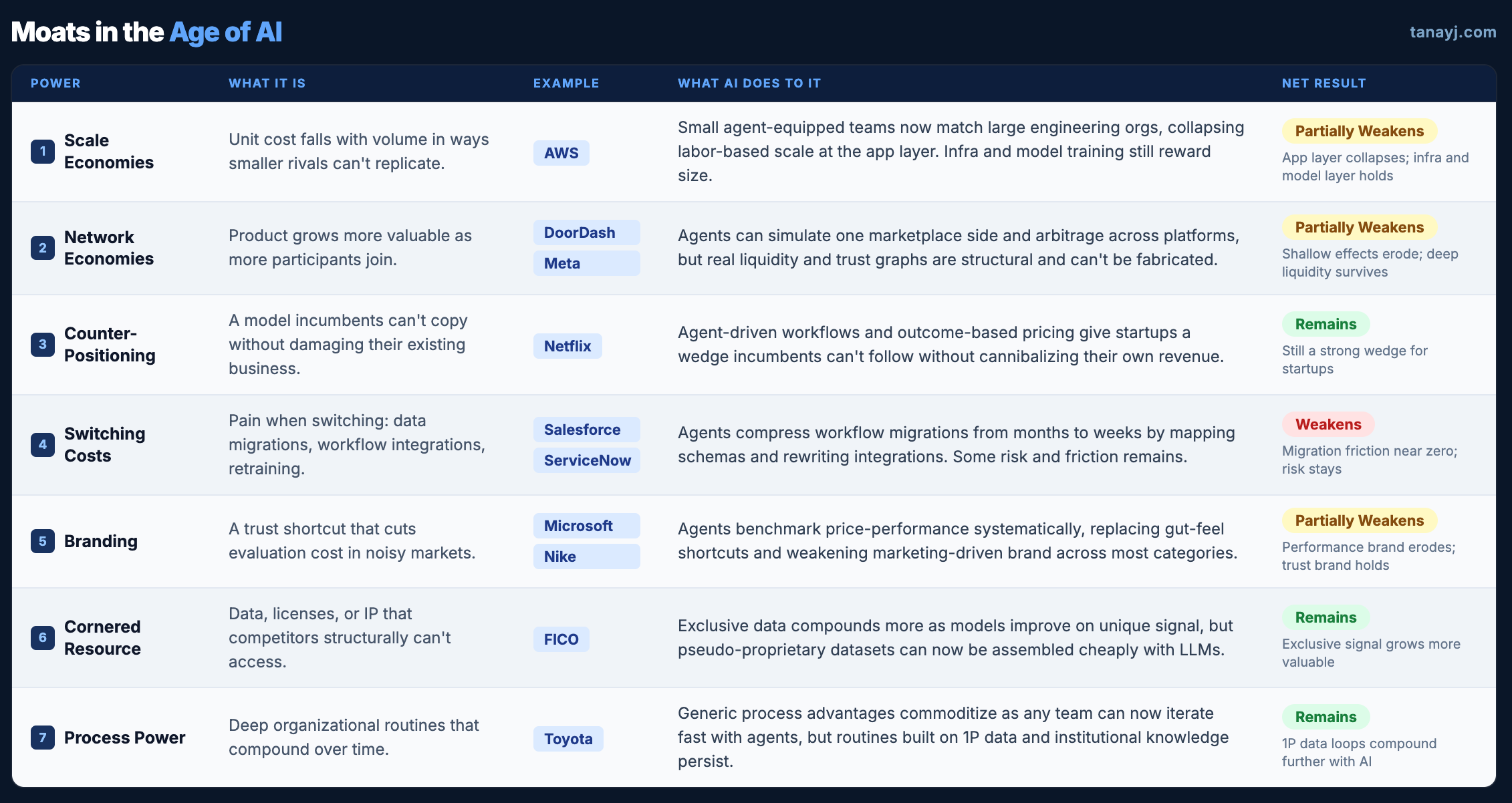
The powers and what happens to them are summarized above. If you’re building an AI-native company, the reality is that default software moat over the last few decades, switching costs, is likely not sustainable. This may actually help you replace incumbents in that it may be easier to migrate customers over, etc, but it hurts your ability to remain sticky.
In this world, defensibility shifts toward cornered resources (typically proprietary data), real network effects (when your line of business supports them), and compounding process power (being extremely AI-native is a good one to start with). Over time you can also built a trust-based brand which also will remain a source of differentiation.
If you’re interested in discussing further or have thoughts or feedback, I’d love to hear from you!