

I’m Tanay Jaipuria, a partner at Wing and this is a weekly newsletter about the business of the technology industry. To receive Tanay’s Newsletter in your inbox, subscribe here for free:
Hi friends,
Bending Spoons went public on the Nasdaq earlier this month. The company raised a bit over $1.5B and currently trades at a market cap of ~$20B. It’s the Italian company behind Evernote, WeTransfer, Vimeo, AOL, and a few dozen other digital products you’ve likely used at some point.
It’s a company worth understanding given its relatively unique approach and model. In this piece, I’ll discuss:
The origin story and portfolio
The playbook in depth: acquire, transform, reinvest
How it compares to Constellation Software
Closing thoughts
I. The origin story
Bending Spoons started in 2013, after the founders’ first startup failed.
The three founders had spent about 3 years building Evertale, a venture-backed app meant to be an automatic diary of your life. It raised around $1 million, and it didn’t work. By mid-2013 they had roughly 4 months of runway and no meaningful revenue, so they wound it down and started Bending Spoons with the $40,000 that was left. Their first acquisition cost $10,000.
The founders write in the prospectus that they came away with a specific conclusion. They had gotten reasonably good at the craft of running a digital business (design, engineering, monetization, marketing), and none of it mattered because they hadn’t built something people wanted.
Finding product-market fit, in their view, has a high amount of luck. Operating a business well is mostly skill.
So the strategy became buying businesses that already have product-market fit, and putting the operating skill into growing them. In their words, they decided product-market fit “won’t be an issue again.”
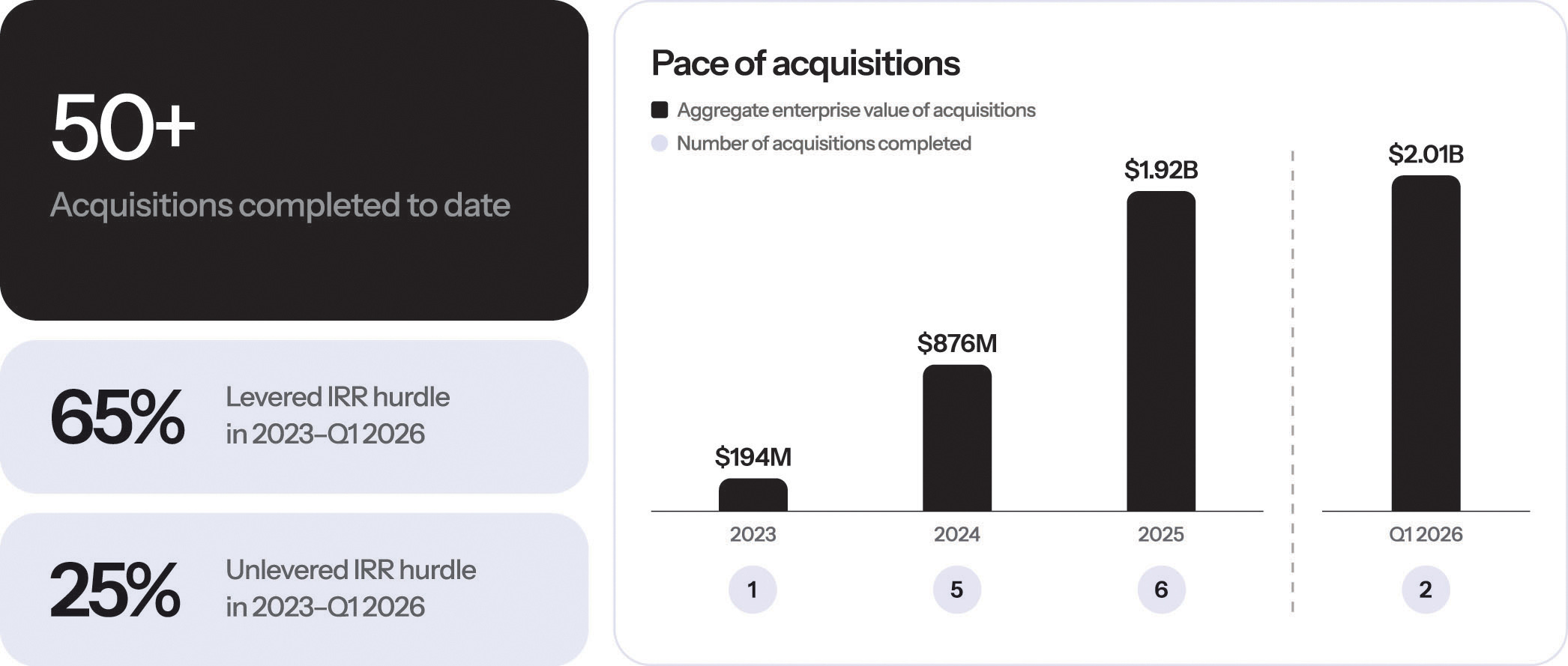
Bending Spoons has acquired over 50 businesses and products so far, and their portfolio reaches over 500 million monthly active users with over 9 million paying customers. Most people have likely used at least one of the products in their portfolio in the past.

The largest businesses are AOL, Brightcove, Eventbrite, Evernote, Harvest, komoot, Remini, StreamYard, Vimeo, and WeTransfer, which together account for over 80% of revenue.
Revenue grew from $387 million in 2023 to $1.31 billion in 2025 (an 84% CAGR), and was $601 million in Q1 2026 alone. Around 84% of revenue comes from subscriptions, with most of the rest from advertising, and roughly two-thirds comes from North America.
Here’s revenue over time, shaded by the year each business was acquired:
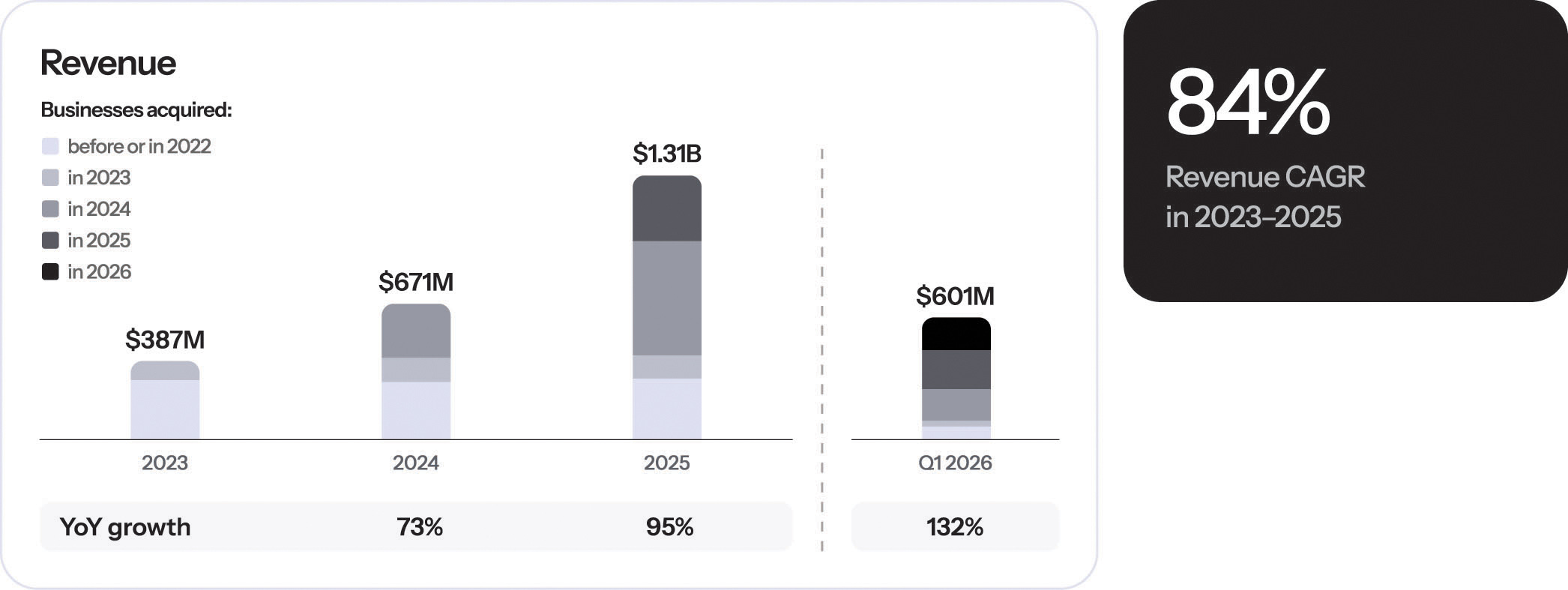
Note that most of the growth comes from acquisitions. Organic revenue growth (their like-for-like measure across the same businesses) was 7% in 2024 and 13% in 2025.
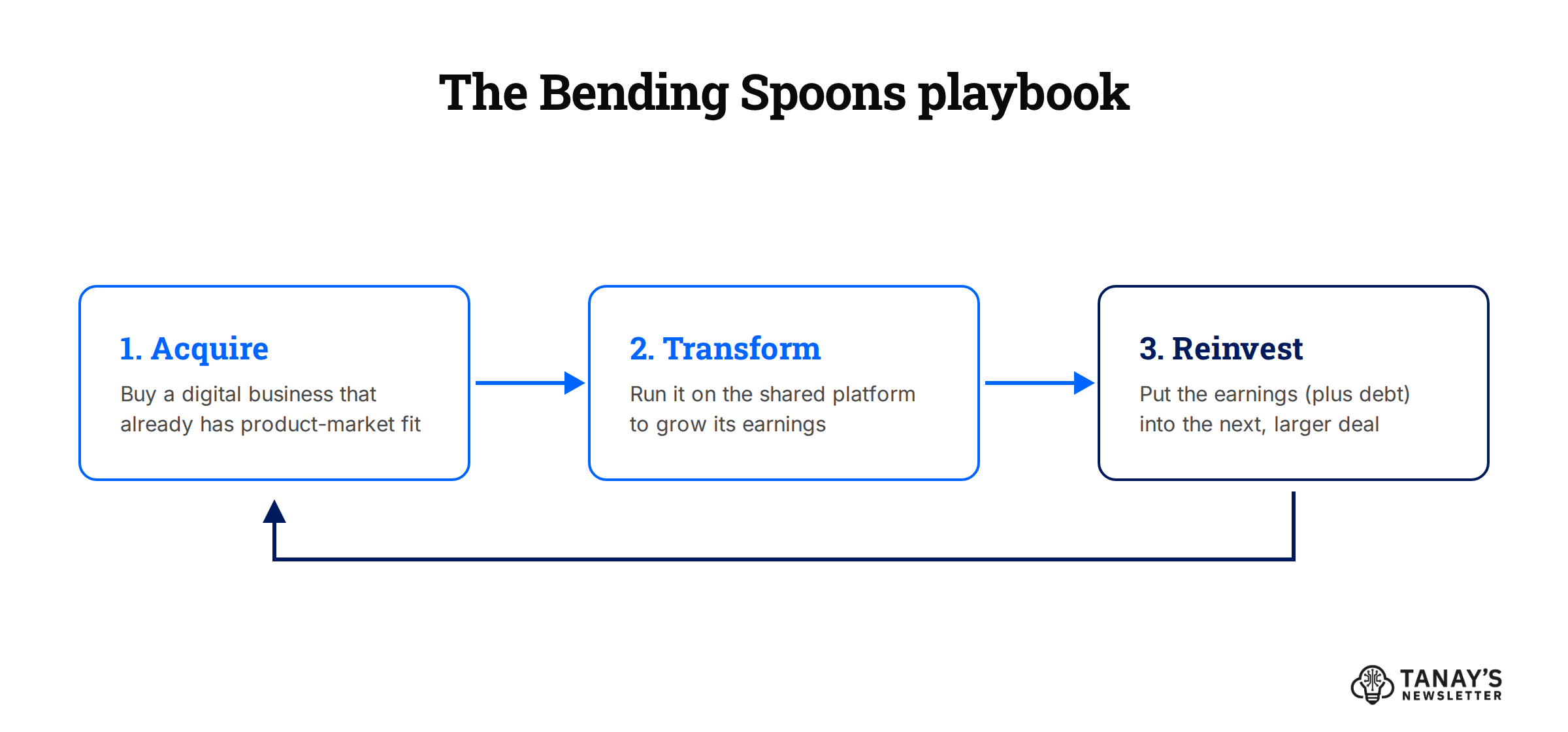
That playbook has barely changed in 13 years: acquire a business that already has product-market fit, transform and optimize it to grow its earnings, and reinvest those earnings into the next deal.
II. The acquisition playbook
As mentioned earlier, the first part of the playbook is to buy and acquire digital businesses with product-market fit.
Every deal is underwritten to a return. Acquisitions from 2023 through Q1 2026 were underwritten to internal rate of return hurdles of 65% on a levered basis and 25% unlevered, and those hurdles stayed constant even as capital deployed grew from $194 million in all of 2023 to $2.01 billion in Q1 2026 alone.
A few things stand out about the approach.
They optimize for returns rather than growth. A target’s organic growth profile feeds the valuation, but the decision is made on expected returns.
They underwrite assuming they’ll never sell, and they haven’t sold a material business in 13 years. They also write that as they scale, the best acquisition may eventually be their own shares, a nod to Henry Singleton’s buybacks at Teledyne.
They fund deals with debt, up to the lower of 85% of a deal’s enterprise value or the amount the target’s projected free cash flow could repay within 5 years.
In terms of the kind of assets they’re excited about: they focus on B2C businesses that have established brands, loyal users, subscription or advertising revenue, and no services-heavy businesses. By their count, that leaves over 1,000 potential targets generating close to $400 billion in annual revenue.
III. The transformation playbook
At a high level, Bending Spoons treats its businesses almost like interchangeable widgets, all running on one shared operating platform which in some ways is the core IP and durable asset of the business.
They describe the platform as three things: their people, their proprietary technologies, and their proprietary data.
Every acquired app get tooling and data that no one of them could justify building alone, and the playbook gets a little better with every deal, because the data from each acquisition feeds the underwriting and operating of the next.
One way to see how the platform rather than any business is what matters is the graph below. The businesses that generated 100% of revenue in Q1 2024 accounted for 24% of revenue by Q1 2026, despite growing in absolute terms, because newer and larger acquisitions kept getting added on top.

So what does the platform actually mean and how does it impact a business they acquire? It encapsulates four main areas.
A. Revenue
The revenue playbook is fairly consistent across deals:
shift monetization toward subscriptions
grow revenue per user (often through price increases)
rely on organic channels rather than paid marketing
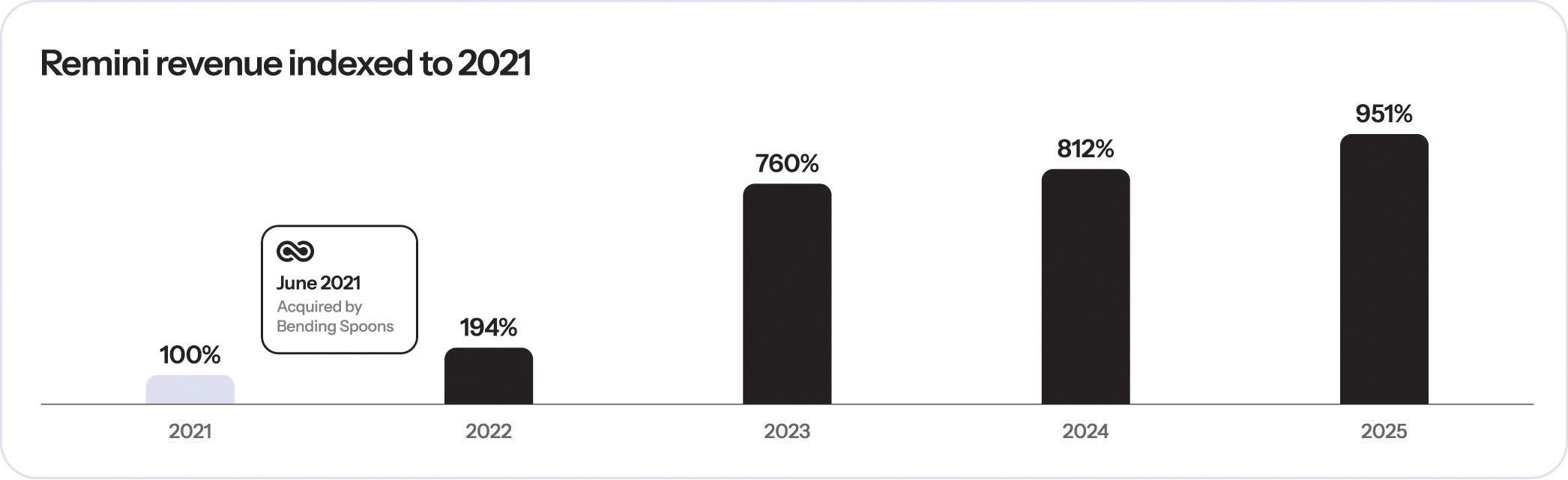
Remini is one clear example of this. After acquiring it in 2021, they shifted monetization from one-time purchases to subscriptions, which went from 43% of Remini’s revenue in 2021 to 85% in 2023. They ran over 1,000 monetization experiments on the product.
Average revenue per monthly active user ended up around 50% higher in 2025 than in 2021, while monthly actives grew more than 5x.
They’re able to raise prices because they almost try to gauge for that in their acquisition process. In Q1 2026, 48% of subscription revenue came from customers with a tenure of at least 5 years, and the revenue-weighted average subscriber tenure was 8 years. Customers who have used a product for a decade tend to stay through price increases, and the rebuilt products give them a reason to.
They also barely pay for growth and improve organic channels like SEO. Organic channels drove 79% to 83% of new-customer revenue across the period, and advertising expense fell from 9% of revenue in 2023 to 3% in Q1 2026.

B. Costs
When they acquire a business, its general and administrative functions get absorbed into shared teams, so a lot of that cost simply goes away. Operating at portfolio scale also lets them negotiate cloud infrastructure and advertising costs across every business, and reuse tooling no single app could justify.
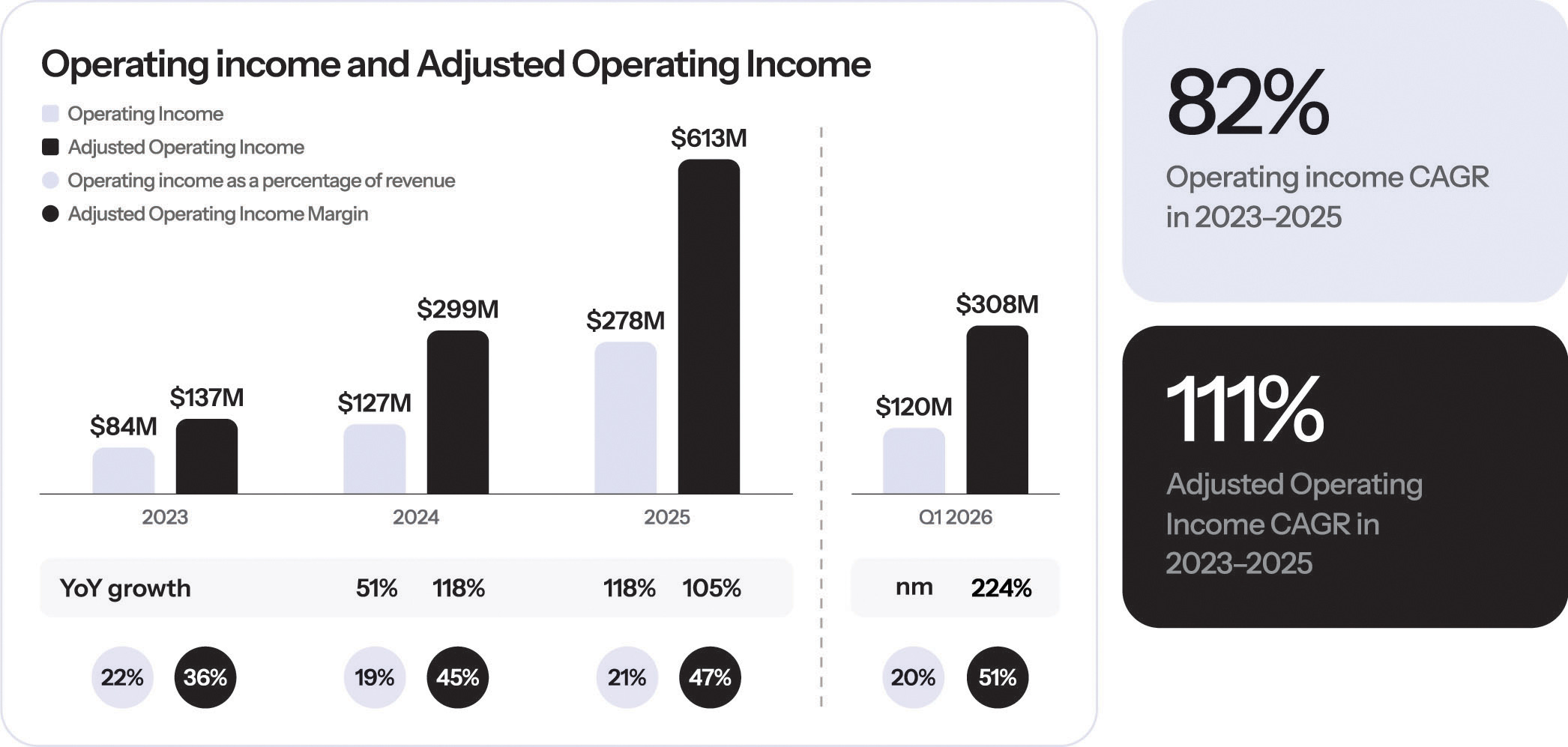
This becomes clear from the margins. Adjusted operating margin expanded from 36% in 2023 to 51% in Q1 2026.
C. People
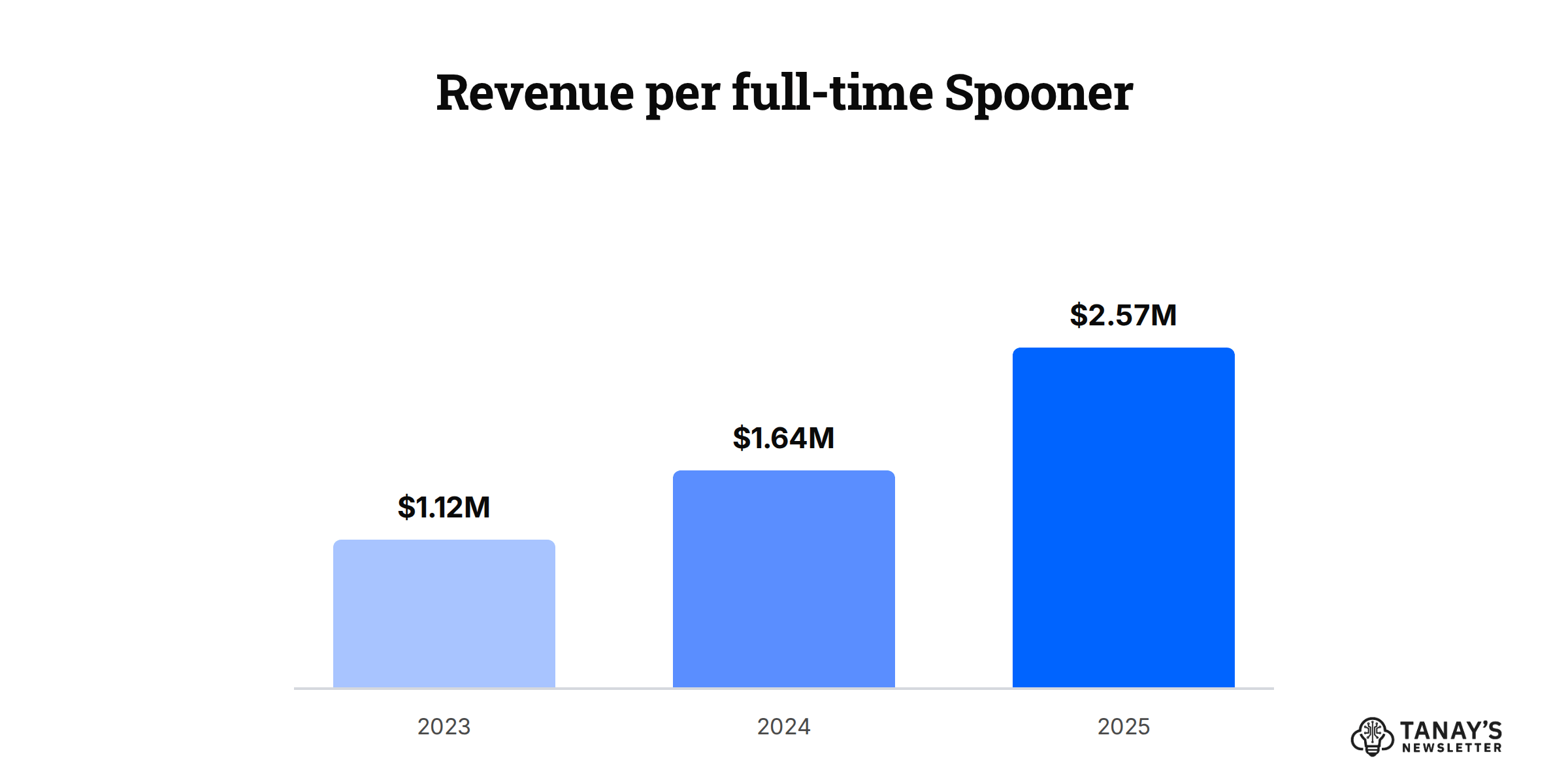
The core team is small relative to the revenue it runs. At the end of Q1 2026 there were 621 full-time Spooners (their term for core team members), just 27% of total headcount, with most of the rest being employees who came with recent acquisitions.
From 2023 to 2025, revenue more than tripled while the core team grew only around 50%. So revenue per Spooner went from $1.12 million to $2.57 million:
D. Shared R&D Infrastructure
The fourth element is the shared R&D infra. The platform includes central data infrastructure, a user lifetime value prediction model, and an experimentation toolkit.
They’ve also embedded AI in their proprietary tools since 2019, and today they use LLMs across products, marketing, monetization, and internal work. Unsurprisingly, the fastest adoption has been in engineering, where the share of code pull requests authored or coauthored by AI went from under 10% in Q1 2025 to over 90% by the end of Q1 2026.
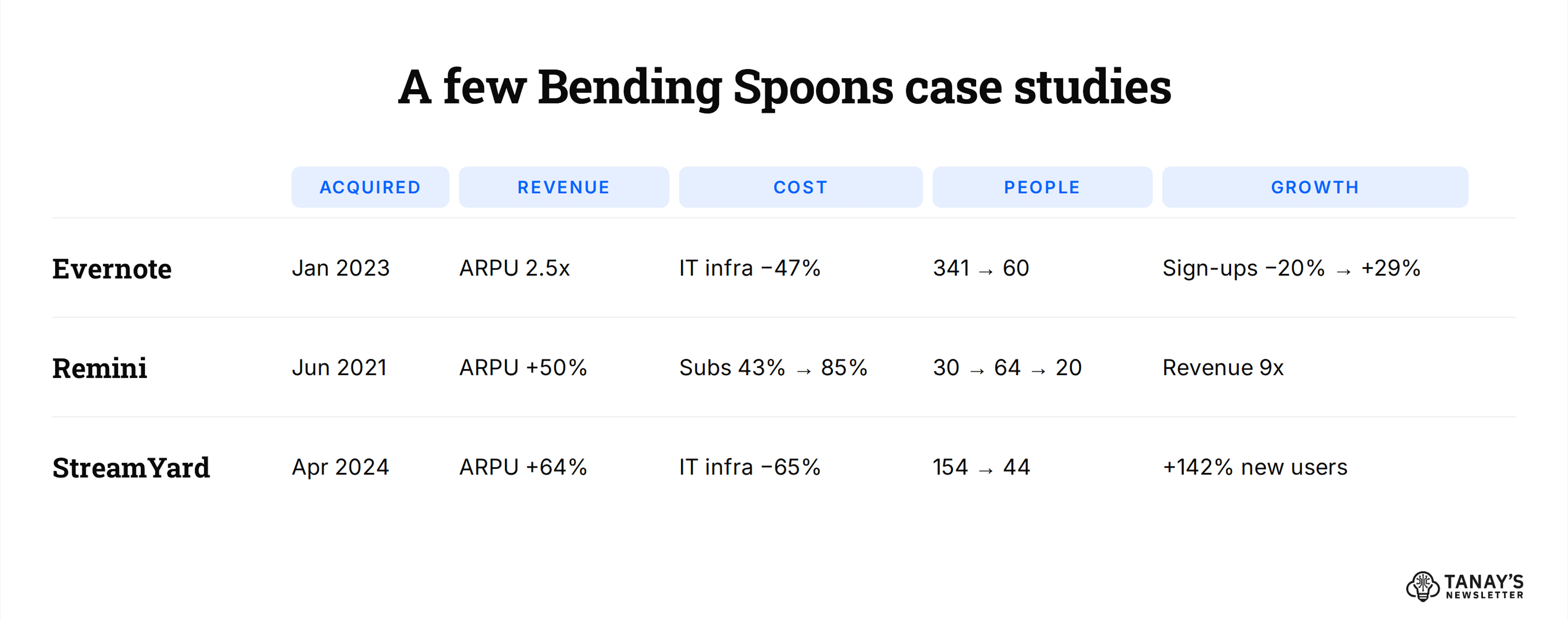
The chart below shows some of the results from Bending Spoon’s playbook
IV. The reinvestment playbook
The last aspect of the playbook is around reinvestment: they take the earnings from the businesses they’ve improved and use them to fund the next acquisition.
The main thing to say here is that do not intend to sell assets nor do they intend to pay out dividends for a long time. Instead, they want to continue to acquire more and more assets, acknowledging that over time they may need to reduce their rate of return on them from the 65% levered rate as they scale.
V. How it compares to Constellation Software
The closest public comparison to Bending Spoons is Constellation Software, which has compounded at around 30% a year for two decades buying vertical-market software. There are many similarities: both buy software businesses, underwrite each deal to an IRR hurdle, hold forever, and treat capital allocation as the primary job.
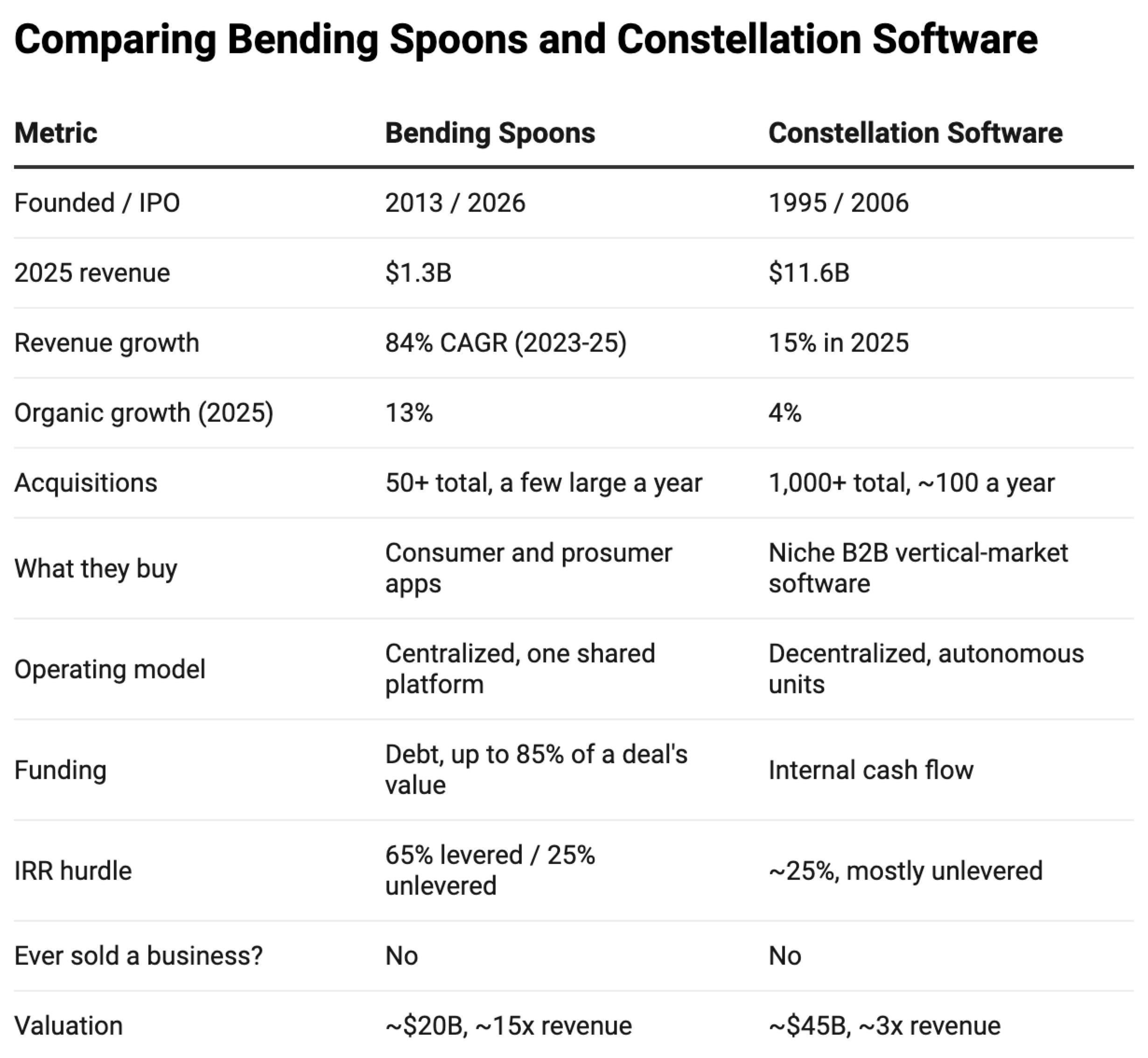
There are also some key differences: Constellation is decentralized, with over 1,000 businesses that largely run themselves, while Bending Spoons folds every acquisition into one centralized platform. Constellation funds deals from internal cash flow, while Bending Spoons uses debt. Constellation buys mission-critical B2B software that rarely churns, while Bending Spoons buys consumer products.
There are the obvious parallels to private equity as well. Bending Spoons borrows the debt and the cost discipline. But private equity buys to sell, typically within 3 to 7 years, and Bending Spoons buys to hold forever.
VI. Closing thoughts
Bending Spoons is such a unique model that sometimes one wonders if there’s anything to learn for a typical business from it? Here are a few things I took away:
Separate the luck bets from the skill bets. Their founding insight is that finding product-market fit is mostly luck and operating well is mostly skill. Being honest about which is which, and putting your energy on the skill side is one interesting takeaway.
The operating machinery can be the product. They view the apps as close to interchangeable and the durable asset is the Platform underneath them. It’s easy to over-invest in the thing you can demo and under-invest in the machine that runs it, and particularly in a world where arguably the cost of creation of software is falling to zero, focusing on the systems that run an organisation can be very valuable.
A loyal, under-monetized base is worth more than new logos. Nearly half of subscription revenue comes from customers of 5-plus years, and a lot of the growth is just charging them appropriately for something they already rely on ather than chasing new customer acqusition.
Decouple revenue from headcount on purpose. Revenue tripled while the core team grew around 50%. Bending Spoons continues to be a great examples of companies taking the idea of operational leverage, particularly in the age of AI and doing more with as little as possible.
The market is pricing it at quite a multiple, around 15x 2025 revenue against Constellation’s roughly 3x, which it will have to grow into. The main risk, valuation aside, is the debt and the interest burden that comes with it. Interest expense was $93 million in Q1 2026 alone, and the model depends on acquired cash flows servicing the loans that bought them.
If you have any comments or thoughts, feel free to tweet at me.