

I’m Tanay Jaipuria, a partner at Wing and this is a weekly newsletter about the business of the technology industry. To receive Tanay’s Newsletter in your inbox, subscribe here for free:
Hi friends,
I hope everyone is enjoying a restful holiday period. As we head into 2026, I’ve been jotting down a few areas in AI and technology that I’m paying closer attention to with some predictions as well. Let’s dive in!
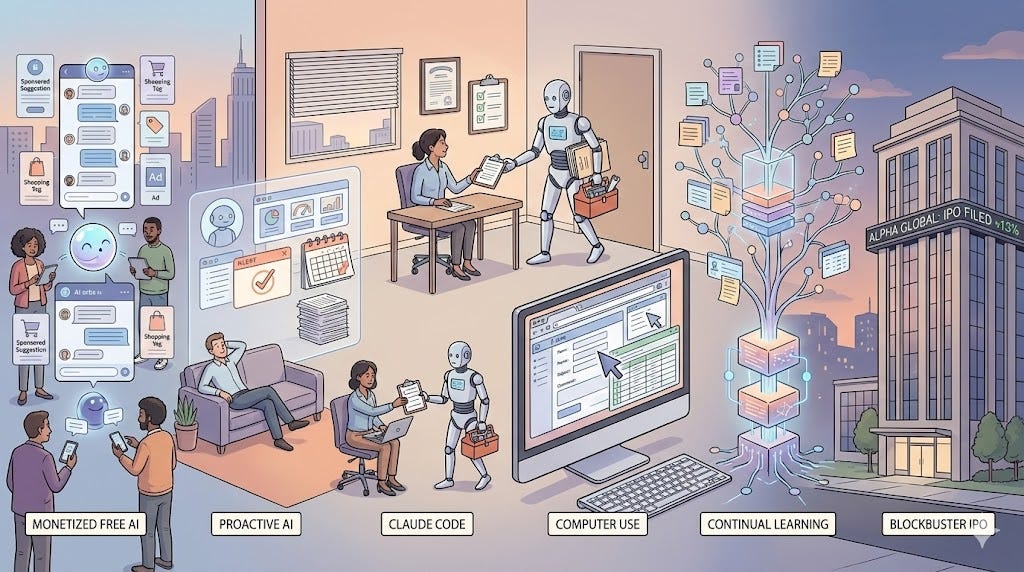
I. Monetizing free AI surfaces
A lot of the most widely used AI products today still have an unresolved question sitting at the center: what do you do with massive free usage at scale?
Subscriptions work well for power users. Enterprise/APIs works well for teams. But neither fully addresses the reality that tens or hundreds of millions of people are using chatbots regularly, often for expensive queries.
I think 2026 is when we start seeing experiments of ads in the major chatbots such as ChatGPT, Gemini and Claude. They probably don’t take the form of ads inside answers, which would immediately undermine trust, but through more separated, carefully designed monetization. Sidebar ads. Related sponsored results. Affiliate-style ads on commerce.
OpenEvidence is reportedly already on a 9 figure run-rate from ads, and highlights that in many cases the commercial intent of these queries is extremely real and that you can’t just rely on monetizing the small fraction that subscribe to paid plans forever.
II. Proactive AI
Most AI today still waits for you to ask.
One of the trends I’m most excited about is the move toward more proactive behavior. Systems that monitor things on your behalf and surface updates, summaries, or drafts without you having to prompt them.
This doesn’t look like a general life assistant. It shows up in narrow, permissioned contexts where the AI already has the right signals. Daily briefs. Alerts when something changes. Work that starts before you ask for it.
We’re already seeing early versions of this with ChatGPT’s Pulse and Yutori’s Monitor, and I expect more products to lean into this over the next year.
III. Claude Code for knowledge work
Outside of software engineering, the dominant interface to AI is still chat. That’s fine for quick tasks. It’s a bad fit for work that is multi-step, long-running, or closer to delegation than prompting.
I think we’ll see something like the equivalent of Claude Code emerge for the typical knowledge worker in 2026. An agentic interface to manage tasks that can take a task, operate for a while, use tools, and come back with completed output rather than suggestions.
Manus is probably the closest thing in spirit today. But I think the category becomes more legible in 2026, even if it doesn’t converge into a single product. It may emerge role by role, the same way people talked about “Cursor for X,” but now in “Claude Code for X” form.
IV. Computer use as a first-class capability
Agents get much more interesting once they can operate the world as it exists today.
That means using browsers, navigating apps, filling out forms, clicking through workflows. Computer use has been an area of focus for a while and we have started to see improvements in benchmarks, but today, at least on true taking action, browser use and computer use are not still reliable enough to do most core consumer or enterprise workflows.
I think we start to see the payoff in 2026, with models that are meaningfully better at doing this reliably - operating applications, filling 10 page forms, etc.
I expect to see meaningful jump in computer use benchmarks, but more importantly in products that can make use of the capability to actually carry out work (beyond the toy book a flight example).
V. Continual learning breakthrough
One research topic that keeps coming up more in conversations is continual learning which is the capability of models to learn new tasks / memory / feedback without forgetting past ones.
Systems that can actually improve over time from experience and feedback aren’t quite there yet. Dwarkesh wrote recently about this being a meaningful blocker for more general intelligence which I agree with.
I don’t think this gets “solved” in 2026. But I do think we see a real leap from one of the frontier labs which also becomes available in the products we use and makes AI feel even more useful. An agent that gets better as it runs is fundamentally different from one that stays static forever.
VI. A blockbuster IPO
Finally, I’m watching the public markets. I think this year brings even more liquidity, in the form of all three, pseudo acquisitions, actual acquisitions and IPOs.
And maybe most importantly on the IPO front, my expectation is that we see at least one (if not more) of the $100B caliber companies file to go public in 2026. Yes, the ones that have been perma-private so far and raised boatloads in the private markets which we questioned whether they’ll ever go public (but not Stripe).
Closing Thoughts
Given how far we’ve come in AI over the last year, when reasoning models were barely getting going, 2026 promises to be another eventful and action-packed year. What are you keeping an eye on this year? As always, I’d love to hear your thoughts, and if you’re building in the first few areas discussed above, feel free to email me at tanay at wing.vc.
On a macro level, there’s obviously a lot of talk about AI and how agentic AI is going to takeover automation for businesses. But on a micro level, how are these tools built and actually implemented into businesses? Will it be centralized by product or do you think the ai tools will need to be tailored to each business’ specific workflow.
I’m currently working on a product for health clinics so would love your input.
Interesting and helpful insights. I have a question about no IV - is Ai navigating browsers/ apps and so on not likely to be a very temporary thing? These are great ways for humans to use computers but surely AI will find better ways to do thing?